Pages

Showing posts with label prose. Show all posts

Friday, February 13, 2015

Metanarrative as a Roadmap to Parallel Universes: "Multiversity" and "Black Science"


Ahead of Convergence – the event which will bring about “an end” to the current phase of the DC multiverse, but not (we are told) to its New Earth setting – Dan Didio has announced changes in editorial guidelines intended to put diverse storytelling approaches before such paltry things as canon and continuity. Whereas there is little doubt that 75 years of contradicting narratives might stick in the craw of a new reader intent on getting acquainted with the DC multiverse, it would be a mistake to operate under the assumption that a more streamlined setting might make complex exposition unnecessary. To be sure, comics’ most celebrated stories rarely depend on the reader’s acquaintance with lore: following the principle of Chekhov’s gun, writers tend to incorporate only the most relevant references to previous works. Be that as it may, crises and retcons would not have become a genre unto themselves if they did not speak to the interests of a significant portion of the comic-reading audience.

It is therefore not unreasonable to surmise that genre readers experience anagnorisis differently than the audiences of other fictions – the comic-reader, looking for coherence beyond the episodic plots, embarks on a personal quest to piece together the metanarrative of an expanding fictional continuum. The editors at DC have not been particularly consistent about providing clear directions on this journey: the original crisis (On Infinite Earths) is the only one of its kind to have a substantial metanarrative epilogue (History of the DC Universe, in which Harbinger details the consequences of the event on continuity). While Final Crisis is certainly a metanarrative – a story encompassing stories – it also raises more questions than it answers.

Grant Morrison’s Multiversity (especially its latest issue, the Guidebook) harkens back to Final Crisis, in part to tie up some of its loose ends, but mainly so as to connect disparate narratives within a coherent, purposeful whole. Despite the inadequate prose of some of its entries, the Multiversity Guidebook conveys a powerful sense of the explosion of narrative into metanarrative, forcing a reflexion on the relevance (or irrelevance) of canons in fiction.

Multiversity
combines metanarrative with metafiction: multiple elements of the setting call attention to the artifactual character of stories, up to and including the metanarrative. Resuscitating a trope from The Flash of Two Worlds, Morrison shows the DC multiverse is held together by the comics medium in a kind of holographic structure: every realm is represented in every other realm in the form of a comic (interestingly, Batman comes to this realization the same way we do: by reading the Guidebook). Metafiction permeates the whole of DC's metaphysic down to its very nomenclature: the orrery of worlds is suspended in an aether called the Bleed, which is to say, in comic-book parlance, the image that runs off the page.

Metanarrative does not have to be an explicit or central element of plot. Most of the exposition in the first volume of Remender and Scalera’s Black Science is not metanarrative per se: the reader is instead made to dance around the story’s chronology, beginning in medias res (as is customary) before witnessing the chain of events leading to the plot trigger in a series of cleverly interspersed flashbacks. Grant McKay and his fellow dimensionauts are adrift in the quantum eververse, the maelstrom of all possible worlds. Though the action of Black Science focuses on a singular narrative thread (that is to say: it does not have to cope with the narrative entropy of a shared universe) it nevertheless has a highly ingenious way of intuiting that other narratives beyond the purview of the reader are equally relevant, especially insofar as they involve alternate-universe versions of the protagonist. The “reality” of the story is thereby shown to be derived from an arbitrary impulse of the reader, a fortuitous consequence of the inclination to make the first given information the central point of any interpretive scheme.

Tuesday, January 06, 2015

"Men kill for the truth because they do not know how to live for it." -- G.W. Wilson's "Air"


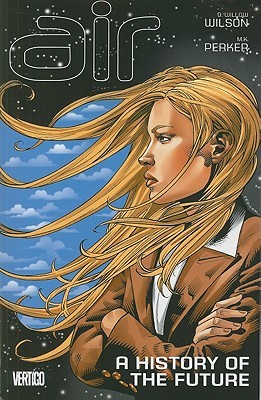
The title for this review is stolen from the second volume
of G. Willow Wilson’s Air.

From 2008 to 2010, G. Willow Wilson chronicled the trials and tribulations of Blythe Cameron, hyperpract extraordinaire. Hyperpracts are (mostly) women and (much more rarely) men, ordinary in every respect except for their singular intuition and fierce imagination. Given the right circumstances, hyperpracts are capable of tapping into the essence of things, manipulating the symbols which ontologically pre-figure reality in order to produce a variety of thaumaturgic effects (though mainly: efficient, expedient air travel).

If my pseudo-metaphysical verbiage does not truly give it justice, it is because Wilson’s Air is utterly unpigeon-holeable. Air is a treatise on the power of words, a meditation on the origins of ideas, a thesis on liminality; it is a narratologist’s fantasy. Air is a pamphlet against both fundamentalism and the extremes of relativism, arguing that symbols are too wild and too precious to bow to any agenda. While certainly a highly satisfying alternate-history/sci-fi yarn, Air is above all a love story -- though not by any means a straightforward one.

Wilson is particularly adept at presenting us multilayered characters, progressively revealing their motivations by unraveling the intricate web of their allegiances. We make acquaintance with certain very colourful organizations in the process, some which we might wish were real -- sky-faring gypsies and punk-rock mujahideens -- others which we cannot help but hate for embodying our own paranoid, parochialist tendencies.

Blythe Cameron is a complicated personna in that she alternates between tumbleweed passivity and extremes of resourcefulness; one might charitably suppose this to be the path a traveller must walk to find herself in a world of unknowables. Thinking back on the story as a whole, I am grateful to observe a tendency towards increasing agency is indeed part of Blythe's evolution.

M.K. Perker’s art is a model of restraint; action scenes (and even hallucinations) are depicted with rare tact and sobriety, leaving more than enough breathing room for the reader’s imagination -- and not a little ambiguity.

Sunday, December 28, 2014

On the Subject of Angry Internets


I feel as though there must be such a thing as "legitimate outrage." Insofar as many traditions in our civilization perpetuate inequality, a "culture of outrage" might not be so bad a thing if it can lead people to take the step from discourse to action.

As Prof. Neil deGrasse Tyson's tweets have never victimized anyone, I fail to see how they might meet the criteria for "legitimate outrage."

Monday, December 08, 2014

Five Things for Which I Have No Patience


1. Verbiage
 All terms used in a manner specific to the argument must be thoroughly operationalized, particularly when they are borrowed from a foreign language. The expectation that all of the participants in the argument must be familiar with specific uses of language in advance of the argument is not only unfair; it is also very poor communicative strategy. 

2. Mistaking etymology for argument
The origins of words and their shifts in meaning, while they certainly present an aesthetic interest, are not germane to the argument. All variables must be operationalized in order to avoid speaking at cross purposes.

3. Mistaking word-play for argument
We are not permitted to infer anything about the facts outside of the language-game on the sole basis of the language-game's internal logic (grammar). Word-play is a creative use of language which by itself cannot reveal anything hidden in the world.

4. Mistaking form (convention) for the point
When trends in discourse (or narrative) reach a certain level of sophistication, it is tempting to ascribe more meaning to their form than to their content or context. This is a mistake: meaning is the whole, and more than the sum of its parts. 

5. Philosophical genealogies
An idea's pedigree does not matter. If an idea is to have any worth at all, it must be able to stand on its own merits without relying on reputation.

Addendum
I should nuance my position by stating I do not object to all theses which call attention to etymology, linguistic or literary conventions -- nor do I take exception to the notion that reading should take authorship into account. The aforementioned variables are all part of the broad situation which comprises "meaning." I only wish to object to the insistence that any single of these (largely extraneous) factors is paramount, or sufficient to argue a point convincingly. Formal logic does not have to be the whole of the argument but it should still be the crux of it under many -- if not most -- circumstances.

I make no reservation concerning my condemnation of verbiage, though. Using "ordinary" language and defining unusual terms is an absolute necessity.

Sunday, December 07, 2014

Weëna


Minnesota, my brother and sister-in-law's feline roommate.
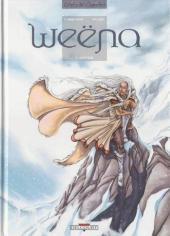
Catsitting takes me out of my usual element. My brother and sister-in-law borrowed some bédés from the local library, and so I read the first two volumes of Éric Corbeyran and Alice Picard's Weëna, an earnest (if derivative) attempt at mythopoeia which may not be available in English at this time. 

Weëna follows the titular character's quest to escape the dark destiny prophesied at the moment of her birth by a grim spectre. The deuteragonist, a young aristocrat with an unpronounceable name, seeks to marry Weëna in order to break an unspecified curse on his bloodline through the sacrifice of their hypothetical firstborn. With the perinatal portents, magical allies and trials of initiation, it sometimes feels as though the author must be writing the script between the lines of a fantasy tropes checklist. All of the characters wear their motivations on their sleeve, making absolutely certain to soliloquize in the most grandiloquent manner at every given opportunity. This penchant for awkward dialogue and frankly juvenile melodrama is highly unfortunate, as poor exposition detracts from the exploration of what might be an intricate and fascinating mythology.

Picard conjures enchanting scenery and striking fauna; the layouts, while not particularly innovative, serve the story well. I personally don't feel compelled to find out what happens to our young heroine, but I suppose there are worse ways to spend an hour with a cat.

Friday, December 05, 2014

"Good is not a thing you are, it's a thing you do" : 3 Reviews


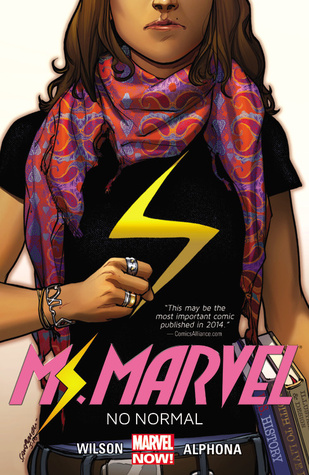
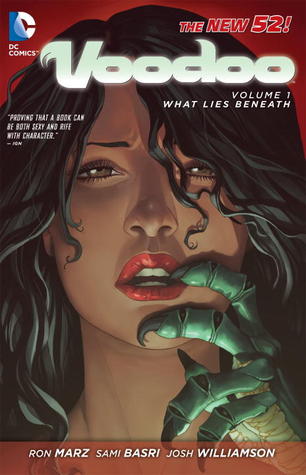
This week I read two (relatively) recent anthologies: the first volume of G. Willow Wilson and Adrian Alphona’s Ms. Marvel, followed by Jeff Lemire and Terry Dodson’s Teen Titans: Earth One. I also perused yet another first volume, the New 52’s Voodoo by Ron Marz, Josh Williamson and Sam Basri. The title of this post is lifted from the pages of Ms. Marvel.

The first six issues of the new Ms. Marvel’s adventures are collected under the fitting title of No Normal, the implication being not only that there is nothing ordinary about a shape-shifting teenager in a world of marvels and monsters, but also that normalcy is itself a construct without any real moral status. Kamala Khan’s struggle to control her newfound powers mirrors her search for a functional identity; the usual sources are not forthcoming with solutions to either problem. American/secular values and familial/religious authority are shown to be as ill-equipped to assist Kamala with her shape-shifting abilities as they are ineffectual at helping her navigate her dual identity. 

No Normal is moreover highly atypical for a superhero story arc: we don’t encounter a real villain before issue 4, and none of the altercations show Ms. Marvel achieve unambiguous victory through the use of force. The focus is decidedly on character development, which is achieved through her many interactions with a colourful cast of New Jerseyan high-schoolers, wage-earners and misfits. Though it may not conform to the expectations of most readers, this focus on character development does not make for a slow pace: fortunately for us, Kamala has a knack for getting into trouble, and her Jersey City environment is depicted in such a vibrant way as to provide much comic relief.

No Normal has many highly interesting things to say about religion and ethics, but it shies away from giving any single character the theological or moral upper-hand. The numenal is encountered in a surrealistic dream-state which is almost a parody of both superhero fiction and traditional iconography. The conversational style of the hierophany undermines the traditional separation of sacred and profane, standing in stark contrast to the stodgy moralism of school and mosque.

+ Watch this insightful video on how Kamala Khan is changing the world of media for the better.
+ Read these G. Willow Wilson interviews with CBR and the New York Times.

. . .

Lemire and Dodson’s Teen Titans is a reimagining of the celebrated Wolfman/Pérez creation for the low-fantasy series Earth One. Focussing on a teen-aged ensemble cast rather than on a single adult protagonist (as in the Superman and Batman novels of the same series) makes for a very different kind of book. The plot’s progress is somewhat hampered by the need to provide background for all six of the main characters so that by the end of the first volume there are still more questions than answers.

In this new incarnation, the Titans are connected by more than just their heroic proclivities; five of them are orphans recruited without their consent into a Star Labs experiment. One can hardly help but wonder how much of the novel’s conflict makes sense seeing how most of it could have been avoided through a few lines of realistic dialogue. The plot depends rather excessively on the teenagers’ rebelliousness and extreme distrust of authority, perhaps even more so than it does on the cynical machinations of machiavellian scientist Elinore Stone.

Despite the seemingly gratuitous conflict, it is interesting to see the trope of the “evil stepmother” subverted in that at least some of  the Titans' foster-parents’ grow genuinely attached to the test-subjects. On the other hand, I am not sure how to interpret Lemire’s decision to make Elinore the architect of Cyborg (instead of Silas, Cyborg’s father in the original Wolfman/Pérez run). As much as I am in favour of reinterpreting popular narratives to include more women in positions of power and prestige, it is not clear to me that turning a martyr into an evil mastermind is an improvement on the source material. 

. . .

Having not read the whole of WildStorm’s Stormwatch/The Authority, I cannot really comment on Voodoo’s (un)faithfulness to earlier source material. The titular character is a mind-reading, shape-shifting human/Daemonite hybrid sent to report on Earth’s heroes in advance of an alien invasion. Marz, Williamson and Basri’s take on the character unapologetically straddles the line between representation and reproduction: while the decision to have a shape-shifting spy pose as a dancer in a strip-club attended by military types makes sense for plotting purposes, Basri’s treatment of the subject leaves little doubt that sexualization was the primary motivation for this creative direction. In fairness to Basri, it could be noted that Voodoo is rarely as sexualized in the story proper as much as she is on the Tyler covers; moreover, Basri exerts remarkable restraint in his imaginative depictions of brutal mayhem.

A vague sense of “the search for truth” drives a fast-paced plot as Voodoo alienates herself from both sides of her hybrid identity, leaving many bloody corpses in her wake. Her only capable, non-superpowered antagonist is revenge-driven special-ops investigator Jessica Fallon; ordinary men are expendable yokels whose hormones rule out the very possibility of free will or lifelike personality. Kyle Rayner/Green Lantern and a new Black Jack are thrown into the fray to remind readers of the larger DC universe in which this otherwise straightforward sci-fi thriller takes place. By the end of the volume, the reader is left in very much the same position as the protagonist, knowing neither where to go nor for which faction to root.

Monday, December 01, 2014

Shazam! The Monster Society of Evil


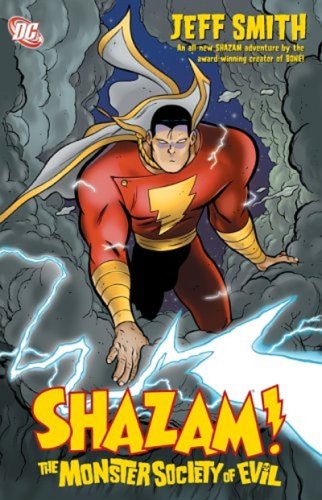
In Shazam! The Monster Society of Evil, Jeff Smith reimagines Captain Marvel’s origins, drawing not only from the Fawcett canon, but also from more incongruous sources such as Middle-Eastern myths and popular physics. These many inspirations are largely ornamental and do not crowd out a story that reads like an urban fairytale. While we do get the sense that the plot takes place in a world which extends beyond the story’s purview, the writer/artist does not presume our prior acquaintance with the characters; all of the narrative threads are neatly contained within the book's 206 pages. Smith’s retelling is eminently accessible, vibrant with character and raw energy.

Despite the tale’s light-hearted, child-friendly tone, Smith manages to throw some strong emotional punches. Captain Marvel’s struggle is not primarily with the cosmic but rather with the mundane; it is the day-to-day troubles of Billy Batson’s life on the streets which stir up the most pathos.

It is much to Smith’s credit that this all-ages title does not shy away from politics: considering it was written in the aftermath of 9-11, the reinterpretation of Marvel’s nemesis Doctor Sivana as the attorney general of “heartland” security can be read as a particularly audacious indictment of anti-terrorist paranoia.

Sunday, November 30, 2014

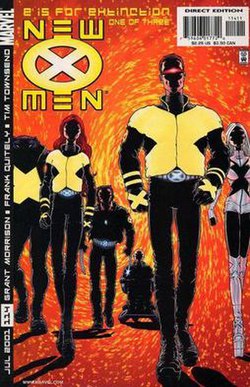
"The only people reading are fanboys who don't count": thoughts on Morrison’s X-Men


I recently read the first two volumes of Grant Morrison’s New X-Men (issues 114-126). Here are some of my impressions:

There are expressions one only ever encounters in Morrison’s works -- phrases such as “I feel like a Hindu sex god” that fall so far outside the category of verisimilar dialogue as to create a genre all of their own. That “sex god” line is delivered by Henry McCoy/Beast, a modern Chiron whose character usually emphasizes sophistication over animality. I do not begrudge Morrison’s eagerness to expose the mainstream to esoteric concepts and turns of phrase, but I rather wish he would do so in a manner that is more mindful of precedents.

The initial arc of Morrison’s run introduces Cassandra Nova, the first of a new psychokinetic species, an evil parody of Charles Xavier. In lieu of the usual characterization, Morrison develops Cassandra Nova as part of a purpose-driven extinction machine, putting forward an evolutionary theory of species-wide apoptosis.Though this is not the first time Xavier is shown to have an evil double, previous writers have shied away from making this trope the cornerstone of any pseudo-scientific eschatology. This is certainly a matter of taste, but I find that -- in the interest of narrative flow -- it may be preferable for writers of speculative fiction not to construct elaborate rationalizations for the scientific plausibility of their scenarios, as this only draws attention to those magical/mythical elements which most contemporary readers are eager to take as given.

The second arc deals mainly with the U-Men, a group unscrupulous transhumanists harvesting mutant organs. The U-Men have a frontman in the person of Elon Musk lookalike John Sublime, but the concept of their movement is actually introduced by a school-shooting teenager. It is refreshing to see the enemy manifest as a largely leaderless ideology instead of a government and/or corporate conspiracy against an innocent minority. 

Quitely’s art is at its most expressive when depicting unseemly mutations; one does not get the impression that the students at Xavier’s are part of a fortunate genetic elite. More than in perhaps any previous incarnation of the X-Men, the reader is confronted with abhorrent disfigurations. Even the more iconic characters are shown in a less dignifying light, often appearing without any kind of distinctive attire. The New X-Men’s work uniforms are clearly more functional than ritual.

Emma Frost, the only exception to this rule, is probably the series’ most problematic character. She is never shown without her X-shaped bikini: one supposes it can stand for either body-positive female-empowerment or male-gaze slavery, but lectio dificilior potior suggests the latter is more likely. I wonder whether Frost’s Machiavellian morality can credibly extend to embrace the instrumentalization of the feminine form.

In an eleven-page manifesto dated October 20th 2000, Morrison states his intention to make the X-Men “cool again,” complaining about the sacrosanctity of status quo in the superhero comic genre.


“ The only people reading are fanboys who don't count. [...] Longtime fans will read the book and bitch about it no matter what. We don’t need to attract them, we need to make the book accessible to the real-world audience. [...] We need to recapture the college and hipster audience because that audience is bigger than ever, and thanks to the movies and games [...] the entire mainstream is pumped and primed to consume super-hero stories.”

With hindsight, it is clear that Morrison’s intuition was largely correct: almost 15 years after his memorable X-Men run, superhero narratives are more popular and influential than ever. Be that as it may, it does not seem as though the superhero paradigm has been in any way subverted. With few exceptions, the superhero narratives developed for mainstream audiences are even more archetypal than their comic-book counterparts. We watch the Marvel cinematic universe with the expectation that an unambiguously prosocial contingent will triumph without suffering significant losses to equally unambiguously antisocial forces -- and our expectations are seldom disappointed. As Northrop Frye wrote in Anatomy of Criticism, "[… W]e could almost define popular literature […] as literature which affords an unobstructed view of archetypes."

Thursday, November 20, 2014

Some thoughts on Chris Claremont's X-Men


I just finished the third volume of Essential X-Men. I had previously been perusing volumes 1 and 2, which means I'm about 68 issues into the Chris Claremont run (in addition to having read a few annuals). I was excited to witness the introduction of iconic characters such as Storm, Nightcrawler, Colossus, and Kitty Pride (not yet known as Shadowcat). These early issues also feature the death, resurrection and second demise of Jean Grey and the Days of Future Past story arc. Here are a some of my thoughts, in no particular order:

Colour is a valuable interpretational aide in comics. Not only does it convey mood (by way of lighting), it also facilitates the decoding of graphically-complex situations. I won't be buying more of the black-and-white Essential editions (unless they come cheap).

Apart from some very male-gaze-oriented outfits and a few gratuitous shower scenes, Claremont's X-Men is relatively light on the sexism. Many issues even pass the Bechdel test. Practically all of the female characters are given complex, independent personalities. Storm is a particularly capable squadron leader (and indeed: much more suited to the task than Cyclops). Claremont does buy into some gender stereotypes in that his female characters seem somewhat more susceptible to irrational fits than their male counterparts (i.e. the Phoenix Force, Storm's claustrophobia which cause her to lash out).

The world of the X-Men is fairly diverse. White Americans are in the minority on the second X-Men roster. Claremont's depictions of foreign and minority personalities are not unproblematic (there's a good deal of exoticizing and some rather ludicrous patois) but the most stereotypical character (the Apache Thunderbird) is sacrificed a few issues after his introduction. One is glad, for once, for the noble-savage-dying-for-his-colonial-friend trope.

Claremont dialogue is better than I remember it to be. I have often mocked action scenes which depict characters delivering long diatribes between punches. The balance between exposition (tell) and depiction (show) is certainly different from what a contemporary comic-reading audience might expect or enjoy, but it's not unjustifiable from a story-telling standpoint. It was a different era with different conventions; many of Claremont's ideas could not easily have been communicated without extensive speech- or thought-bubble commentary.

Claremont has interesting ideas about religion. In issue #108, he throws some kabbalah at us: 
 "In that instant -- as she feels her power, the power of her friends, sing within her; as she reenergizes the energy lattice -- it's as if a door has opened before her eyes. A new pattern forms -- shaped like the mystic tree of life -- with Xavier its lofty crown and Colossus its base. Each X-Man has a place, each a purpose greater than himself or herself. And the heart of the tree, the catalyst that binds these wayward souls together, is Phoenix. Tiphareth. Child of the sun, child of life, the vision of the harmony of things."
It is not at all suprising that Phoenix was designated to undergo apotheosis, but I am at a loss to explain why Claremont opted for kabbalah as his frame of reference for mysticism. Claremont's Jewish heritage notwithstanding, it seems to me as though there might have been more popular or obvious options at the time. It is possible he chose kabbalah precisely because it was not exceedingly well-known. I am not convinced his interpretation of the sephirot is kosher, but I am not an expert. Perhaps this is irrelevant, or perhaps it is cultural instrumentalization -- I am not sure.

In X-Men Annual #4, Doctor Strange accompanies the X-Men on a trip through Dante's Inferno to rescue Nightcrawler. I am not at all sure what to make of that issue.

Tuesday, November 04, 2014

Our Panoptean Times?


I am not by any means a philosopher, let alone an expert on Nietzsche. Be that as it may, I believe I have read enough about the Saxonian master to appreciate his disdain for the stultifying influence of dichotomous thinking. As the work of a true visionary, Nietzsche’s tearing-down of essentialized binaries prefigures recent critiques of structuralism: internal life is not made up of unequivocal categories, like fixed stars; it comprises shifting constellations of meaning, shaped by human struggles.

It was recently suggested to me that myth might be a Dionysian cure to present-day Apollonian excesses.

While not without merit, this claim presents a certain number of problems. It suggests myth is primarily Dionysian, and assumes that Western societies are predominantly Apollonian. I wish to suggest an alternate narrative, and perhaps recommend another god to represent our era.

Given the Nietzschean rejection of many conventional dichotomies, it is telling that he should conjure the brothers Dionysus and Apollo to explain art and the world. It is probable Nietzsche believed eternal myth would carry more weight and authority than most conventional concepts of criticism.
The suggestion that myth is Dionysian -- spontaneous, intuitive -- is somewhat undermined by Nietzsche’s invocation of the divine pair for the purposes of criticism. Nietzsche instrumentalizes myth in order to draw fine distinctions, to engage in analytical discourse. Mythic concepts lend themselves to this exercise and so they are intuitively grasped, but very little about this intertextual approach is spontaneous. As Nietzsche is not the first to resort to myth in this manner, one might suspect he is taking a stance against Plato's -- his nemesis -- or else contradicting religionists who offer up less sophisticated readings of myth as the basis of their morals.

If myth or mythopoeia can be used to clarify language and experience, it is possibly because it precedes both epistemologically. It seems we are heuristically better suited to extrapolate lexica from narratives than from other lexica. It is something of an aporia that symbols are intuitions at the basis of our systems of meaning which nevertheless require methodical discourse in order to be made intelligible. Myth is both Dionysian and Apollonian, or possibly neither.

Everyday experience provides ample evidence giving the lie to the assumption that our Western societies are governed by the Apollonian principle (i.e.: rationality, analysis). To be sure, we tend to value methodical thinking over spontaneity under most circumstances, but we are not always aware of our own motivations, nor even particularly consistent at applying the strictest standards of rationality. Advertisers know very well that we do not often consume rationally: their art is to create situations in which we might relax our standards, shrug off the rational pressure to examine our options critically, and direct our aspirations according to non-utilitarian principles. Advertising may not dictate all of economic behaviour -- consumerism may not define us entirely -- but it seems unlikely that the omnipresence of marketing messages does not condition us very significantly.

I surmise the greater part of our decisions concern our consumption in one way or another; at least some of these decisions are swayed by advertising narratives which flout Apollonian ideas. To the extent that we are consumers, we are not, therefore, Apollonian. But consumerism is merely one indication to the effect that Western societies are only superficially rational; there are other signs, like our reluctance to investigate information which contradicts our self-serving narratives of citizenship, race, and gender.

But if we are not Apollonian, what are we? I do not purport to have Nietzsche’s talent for mythological metaphor, but I do have a suggestion. If I am to draw any conclusion from my study of McLuhan’s observations, it is that we have become Panoptean (after Aργος Πανόπτης, the thousand-eyed shepherd) insofar as we are over-informed. The contemporary human is awash in an ocean of competing signals, her senses hyper-extended to the point of taking her own omnividence in stride. The consequence of this condition on the individual and collective psyche is panic; this is evidenced not only in the tone of round-the-clock newscasts but also in the overwhelmingly contrarian attitude of popular online discourse. Intellectually, the tendency of the contemporary media environment is to keep us always in the frantic state of fight-or-flight, or else charging us to proclaim grievous loss, like the voice out of Palodes.

Sunday, October 26, 2014

The Hero With a Thousand Faces


"The gods as icons are not ends in themselves. Their entertaining myths transport the mind and spirit, not up to, but past them, into the yonder void; from which perspective the more heavily freighted theological dogmas then appear to have been only pedagogical lures: their function, to cart the unadroit intellect away from its concrete clutter of facts and events to a comparatively rarefied zone where, as a final boon, all existence -- whether heavenly, earthly or infernal -- may at last been seen transmuted  into the semblance of a lightly passing, recurrent, mere childhood dream of bliss and flight." 

Considering how much of his exegesis celebrates the heteronormative male's dominion over female elements, it is perplexing to witness Campbell prescribe mythic thinking as a solution to our supposed crisis of meaning. Neither the imitation of the hero nor the metaphysical interpretation of his journey as a testament to the eternity of the Self constitute a clear guide for everyday living. Were Campbell correct in assuming the decline of the myths' influence, we would still be hard-pressed to find ethical grounds for their restoration to an honorable place in pluralistic societies.

According to Campbell's monomyth, the hero (typically: a man) is part of a diad with his God, (usually: a paternal figure) who confronts the former with the shattering revelation of the hero's own truth. The hero's journey is itself a metaphor for that truth, which is ultimately the realization of some great universal unity. The hero's trophies (i.e. his rescued princess!) are purported to symbolize the elevation of consciousness to that unitarian vision.

Campbell's contention is that all of myth has but one message, audible on that high frequency of mystery, the exalted level at which ordinary signification breaks down. The message is a metaphysic of the constancy of undifferentiated Being, in which we are supposed to discover a justification for all of our suffering and travails (amor fati).

A sober-minded intellectual might instead entertain the possibility that mystery is a reference without a clear referent; the semantic dance of mythic narratives may not conform to a unified theory positing anything more than categories to use for legitimate comparison. One might even suggest that mystery is not media but the point where meaning ends -- for good or ill, the frontier of arbitrariness.

And so: Campbell's genius lies not so much in finding coherence but in articulating schema on the basis of which to comment on similarities and differences. In that respect, his monomyth is immensely valuable. Despite his excessive eagerness to promote his own brand of stoicism as the origin and essence of all myths, his denunciation of literalism and theological parochialism is certainly much to his credit:

"Mistaking a vehicle for its tenor may lead to the spilling not only of valueless ink, but of valuable blood."

Monday, April 14, 2014

Diary: A Novel


This one is delectably erudite and rife with half-truths. It seems that taking liberties with History is rather the point and the art of it. We must reclaim our freedom from History, from the "collective unconscious" and other forms of maieutics, as these are not emancipatory forces. Theirs is an ancient and insidious kind of domination, like the karmic cycle which we must escape.

Thursday, April 10, 2014

Fight Club


It must be added to the "list of novels I did not like," not because it is poorly written or uninteresting (quite the contrary) but because I feel strongly that ...


1. ... there are many acceptable ways to be a person, and/or a man, and/or fatherless;
2. ... there are at least as many legitimate ways to be free.

One can choose to be completely determined by history or not -- a cynical corporate whore or not -- a raving, Chaos-worshipping urban savage or not. One is free to do what one can with oneself, to love others and oneself. Maximum smashism is not the only -- nor necessarily the most exalted -- mode of being.

Angry folk will inevitably read some kind of hypermasculinist gospel into Fight Club even though the book does not make any unequivocal claim to that effect, and so: I can't completely like Fight Club, because there are still angry folk who read books, and I wouldn't want to endorse their interpretation.

Saturday, March 23, 2013

Making Comics by Scott McCloud


Advice is cheap. And plentiful; the electronic ether is alive with the voice of a million gurus and charlatans, some well-meaning, some egotistic, most a combination of the two. I have myself occasionally operated under the delusion of having heard the plea of the ignorant; of being capable – nay, required – to impart necessary knowledge. This, as the Teacher put it, is vanity.

The superabundance of short guides and SparkNotes indubitably has many advantages, though it also tends to make it more difficult to focus on those works wherein one might find substance worthy of sustained attention. Scott McCloud’s guides to comics (Understanding Comics and Making Comics) fit squarely in the category of "must read" in that they creatively synthesize many compelling theories about art and storytelling. Though McCloud focuses on sequential art, all creators should be able to appreciate his psychology of artistic experience, which focuses heavily on the audience’s appropriation of the narrative.

Best of all, McCloud’s guides are extremely pleasant to read. Jargon is kept to a minimum and even the most complex of concepts are elegantly illustrated. The books criticise many forms of dogmatism prevalent in the arts, and such critiques are made more convincing by their author's admission of his own biases. McCloud provides a detailed bibliography of his sources, and is otherwise very demonstrative of his gratitude towards his many inspirations.

Making Comics suggests creators remain mindful of the following five story-telling goals:


1. Look for stories that are rooted in your own experience and that speak to the experiences of your readers

2. Find new and interesting kinds of conflicts between characters

3. Surprise your readers

4. Provoke emotions by tapping into common heritage and experience

5. Make your audience care

Though McCloud’s practical advice may seem initially obvious, it is the kind of sound logic which tends to get drowned out by impulses and aspirations – in other words: it bears repeating, if only on account of how seldom such wisdom is taken to heart.


Tuesday, March 12, 2013

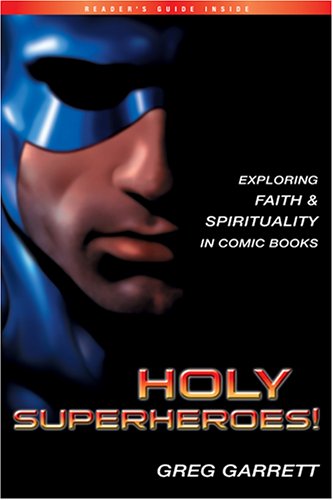
Holy Superheroes! by Greg Garrett


With Holy Superheroes!, Prof. Greg Garrett delivers an unpretentious exploration of Christian morality through favourite comic-book exemplars. 


The work is not particularly critical of the genre, nor is it exceptionally wide-reaching in its philosophical scope. Other books, such as the Blackwell Philosophy and Pop Culture Series, have deployed much more significant efforts in exposing lay audiences to ethical and metaphysical concepts through popular media. Prof. Garrett’s exposé deviates significantly from the tried-and-tested approach by focusing on moral lessons instead of philosophical questions. While the wealth of the author’s frame of reference leaves no doubt as to his erudition, sophisticates will likely sneer at the simplicity of Prof. Garrett’s interpretations and the way in which they betray his own biases. Holy Superheroes!, evidently, is intended more for the mythical Everyman than for the collegiate or post-collegiate reader.

It should not be thought that the kind of book which Prof. Garrett writes does not have its place in the forum of serious discussions on speculative fiction. Candour, and even a certain naïveté, can be refreshing, grounding us when we would get lost in technicalities. We must never forget that, at their core, stories are words exchanged between human beings; the complex interplay of overarching ideologies, while fascinating to academics, is of secondary interest to the majority of readers.

Prof. Garrett’s prose, while adequate, becomes something of an impediment to his message when he veers inexplicably into the realm of the colloquial, like an overenthusiastic preacher or a self-conscious teacher trying too hard to be cool. The book’s last few pages present some interesting recommendations grouped by theme; much to the author’s credit, some of these titles may surprise the non-religionist on account of their overt irreverence. 

Tuesday, March 05, 2013

Robert Mayer's Superfolks


Robert Mayer’s Superfolks has been recognized as a seminal work of the modern superhero genre; it is allegedly one of the first novels to focus on the ordinary lives of extraordinary beings. Popular opinion suggests we ought to thank Mr.Mayer for inspiring the more “serious” and self-conscious approach to writing comics that arose in the 1980s, making Superfolks a spiritual predecessor to such graphic-novel milestones as Alan Moore’s Watchmen.

While Superfolks should rightly be praised for its fascinating examination of the tension between the humdrum and the heroic, it would be inaccurate to laud it as much of a literary first. Many of the earliest adventures of Superman depended on this same tension to drive the plot forward. Even a cursory review of the Golden Age episodes will attest it was not Truth, Justice, and the American Way that weighed most heavily on the mind of the Man of Steel: it was rather his secret identity, which he protected from Lois Lane through farcically elaborate methods. Given a different narrative direction and more time for the medium to mature along with its audience, these neurotic elements of the Superman mythos might very well have come to be exploited with the same kind of irreverence found in Superfolks.

It is somewhat paradoxical, moreover, that we should credit Superfolks – a work of parody – with inspiring a more honest, transparent use of comic-book tropes. Though at times profound – even erudite – and quite masterfully written, the novel nevertheless disappoints by dedicating far too much of the author’s indisputable talent to making scenarios for the interplay of dated clichés about sexual inadequacy, infidelity and gender confusion. The most successful, most inspiring parts of Superfolks are in fact the ones which aren’t trying to be funny, and this can be fairly disorienting for any reader opening the book with different expectations.

Tuesday, February 26, 2013

Everyman's McLuhan


There are ideas for which continuous, systematic prose is decidedly not the best mode of expression. Marshall McLuhan’s process aims to interrupt the trance-like state into which media lull us. To remain faithful to its subject, a McLuhan primer would necessarily have to integrate this interruptive approach to its presentation.

W. Terrence Gordon’s Everyman’s McLuhan presents McLuhan’s life and thought in a startling flurry of words and images which force the reader to reflect on their coherence and contradictions. The effect is reminiscent of McLuhan and Fiore’s The Medium is the Massage, but the prose is comparatively more accessible, being more explicit and drawing analogies which should not leave a lay audience too confused to take anything home.

W. Terrence Gordon masterfully summarizes McLuhan’s 1964 classic, Understanding Media: The Extensions of Man, in ten miniature essays. I have further digested six ideas found to be most emblematic of McLuhan’s approach to regurgitate them here for your convenience:

  • A medium can be any extension of the human being; we are, in fact, the content of every medium.
  • Media operate in pairs, each paradigm “containing” the previous paradigm ...
  • ... except for thought, which has no anterior medium, being non-verbal and pure process.
  • Media create environments, and their effects tend to deprive us of the control to use them effectively.
  • New media do not so much replace each other as complicate each other.
  • Media can be classified in terms of how much participation (how much interpretation) is required of the audience; “hot” media represents a higher degree of stimulation than “cool” media, which provides a less comprehensive experience.


W. Terrence Gordon’s presentation is not without problems – the selection of examples of “hot” and “cool” media seems a bit suspect to me – but on the whole it is a legitimate starting point for some out-of-the-box thinking.

Friday, February 22, 2013

An Unlikely Prophet by Alvin Schwartz


“Genre-defying” is not a term one should throw around willy-nilly. “Genre,” after all, functions as a category for comparison. Placing a work outside of genre relegates it to a gray area beyond the reach of much conventional literary criteria.

But every now and again there comes a book which is genre-defying in the truest sense. Comics great Alvin Schwartz was likely aware that his last work, An Unlikely Prophet, would prove difficult for his audience to categorize – and so the original 1997 edition was subtitled Revelations on the Path Without Form, setting it well outside the realm of conventional fiction and into that of esoterica. The 2006 reprint used a different subtitle, likely a new publisher’s sales-pitch: A Metaphysical Memoir by the Legendary Writer of Superman and Batman.

Mercantile logic notwithstanding, that latter subtitle is perhaps more revealing as far as genre is concerned; as a first-person narrative, An Unlikely Prophet is very much a memoir, though one that is largely fictionalized – allegorized, even – to tackle metaphysical notions. The novel is reminiscent of Richard Bach’s Illusions, Herman Hesse’s Siddhartha, or the best documents of the New Thought movement in that it blurs the ordinary distinction between thinking and reality. Mr.Thongden, the character whom Schwartz uses as a mouthpiece for his esoteric views, is masterfully introduced and developed, being revealed early on to be a tulpa (a kind of thought-golem). Schwartz’ prose is mature and researched, seamlessly integrating references to the Fine Arts, Hawaiian and Tibetan ethnography, neurology, and new physics.

An Unlikely Prophet’s pacing might have benefited from the use of more diverse situations in which to explore the ideas being presented; be that as it may, this is a small complaint considering the novel’s short length. As the book lends itself to many levels of interpretation, readers uninterested in the author’s metaphysical persuasion may still find it an interesting exercise in the style of magical realism. 

Thursday, February 21, 2013

Perry Moore's Hero


I should stop basing my expectations on endorsements. I recently bought Jane Yolen’s The Last Dragon because it came with Ursula K. Leguin’s stamp of approval; I was hoping it would turn out to be a graphic novel successor to the Earthsea series. The Last Dragon was certainly an elegant, non-standard fantasy, featuring empowered women and a different kind of problem-solving than is typically found in the mythopoetic genre. Unfortunately, I cannot honestly say that it was erudite, nor very psychoanalytical – in other words: not nearly as deep as Leguin’s work.

I have had similar experiences with Perry Moore’s debut novel Hero. This superhero bildungsroman constructed around the character of a gay metahuman was endorsed by Stan Lee and Maurice Sendak (amongst others). I suppose I was expecting something of Lee’s punchy narrative genius, or else a dose of Sendak’s introspective surrealism; I got neither.

My reading was haunted by vague intimations of what an excellent novel Hero could have been if it had fallen into the hands of a more capable editor. The writer conjures endearing characters, but these are mostly shown at their worst, as though they need to break down before they can open up. Moore’s style gets very awkward at times; it alternates between character development (nearly always in the form of personal crises or confessions) and a rather convoluted plot. Being extremely personal, the themes of identity and orientation would be best presented in a more allusive style. Instead of placing the inner struggles at the forefront of the narrative by making them terribly explicit, I feel as though hinting at the characters’ emotional tensions/ambivalence could have helped me sympathetize with them. It is preferable to risk giving readers too much interpretational freedom rather than force them into identifying with characters whose struggles and foibles are very much exclusively their own.

Hero’s flow is hindered by Proustian flashbacks and imprecise descriptions which make action sequences very difficult to understand; this is particularly regrettable considering the lengths to which the author goes in order to establish the novel in the superhero genre.

Despite Moore’s shortcomings as a storyteller – which we might have expected him to transcend had his life not come to a tragic end in 2011 – Hero constitutes a bold and laudable attempt at lending a legitimately gay voice to the superhero genre.

Monday, March 23, 2009

Nicholas Hughes


A. Alvarez's The Savage God is one of my favourite books. I am especially grateful for its prologue, which details the life of Sylvia Plath and the way in which despair stalked her, leaving its black trace everywhere in her writings. At a time when I was somewhat disturbed it helped me achieve a certain clarity of mind I could not have afforded otherwise. The essays treat suicide as the real course of action of real people. Alvarez stares the monster straight in the face rather than cajoling it or calling it bad names, avoiding the mistakes of less knowledgeable authors.

Now, to be completely honest I have only read snippets of Sylvia Plath -- The Bell Jar, and sundry poems forwarded by disreputable acquaintances. I have heard more intelligent individuals berate Plath's works extensively. Though I am not exceptionally sophisticated when it comes to literature in general, I reject such critiques. Plath's oeuvre is heavy with a sense of existential pain to which every human being should be sensitive; to put aside such sensitivity, even for the sake of higher criticism, is to make humanity subordinate to academia. It is an aesthetic fallacy.

I would rather we abolished most of those "discriminating standards" in literature. The Sylvia Plaths might still die, leaving vast empty wastes in the wake of their brief and brilliant lives, but perhaps their deaths would appear less futile, and-- we can only hope -- become less frequent.