Pages

Showing posts with label reviews. Show all posts

Thursday, April 16, 2015

How Catholic is "Marvel's Daredevil"?


In  her review for Patheos, Kate O'Hare writes:

I’ve seen five episodes, and Murdock, played by British actor Charlie Cox, has gone to Confession once, in the pilot — granted, he’s seeking absolution in advance, and he’s told that’s not how it works — and then there’s the above quip about Catholicism, from a later episode. But, other than that, faith doesn’t seem to be a big topic of conversation.


I concur that Catholicism is mostly there for flavour in the first few episodes.

Religion and religious narratives eventually become the show's foremost source of moral clarity, the standard according to which the main characters (Murdock and Fisk) make sense of their actions. Father Lantom has a number of encounters with Murdock, and his religiosity comes accross as the lifelike expression of a complex, living faith that has successfully undergone the harsh test of experience. Fisk delivers a thought-provoking monologue on prayer; in the final episode he has a striking moment of lucidity in which he quotes the parable of the good Samaritan at some length.

All things considered, I thought it was refreshing to see a show in which religion is not short-hand for inflexible or naïve dogmaticism. I was impressed with the way death had deeply-felt impacts on character development and plot; I find television writing does not usually dedicate much time to the theme of mourning.

Friday, March 20, 2015

"You see a Hulk, you run."


Overwhelmed by academic commitments and an overabundance of television (besides other distractions) I have had to put off reviewing the comics I have read over the past two weeks. I endeavour to correct this situation with this post. The following is a review of Soule, Pulido and Wimberly's She-Hulk (volume 1: Law and Disorder), Matt Fraction and Chip Zdarsky's Sex Criminals (volume 2: Two Worlds, One Cop) and Jonathan Hickman's Pax Romana. The title of this review is uttered by Herman Schultz (the Shocker) in She-Hulk #5

“Lady, all I know about you is that you're tough as hell. Guys like me, we got a list of people like you. Like a rating system. You got your Daredevils, your Iron Fists – those guys, you fight. Maybe you get lucky, or maybe you're actually good enough to beat 'em. Now, any Hulk – lady, dude, red, green, purple – you see a Hulk, you run."

Soule is exceedingly adept at weaving together character exposition and fast-paced narrative: consequently, the latest adventures of Jennifer Walters (aka She-Hulk) should prove enjoyable to just about any human-like creature with a functional heart and brain. Soule's plot is precipitated by an unfair performance review after which Walters leaves her law firm to fend off on her own. Serendipitously, Holly Harrow, the widow of a small-time supervillain, seeks compensation for use of her deceased husband's technology by a Stark Industries subsidiary. After using her Avengers connection to settle out of court, Walters uses her payment from the case to start her own practice. Strange cases have a way of finding her – strange cases and bizarre people, including the sardonic paralegal Angie Huang.

The first four issues of She-Hulk are illustrated in Pulido's vibrant pop-art style; Wimberly's art in issues 5 and 6 has a different, more psychedelic energy which suits the narrative direction, though the transition is indeed jarring.

♀♀♀♀: Soule's She-Hulk features a variety of different relationship styles. Walters' practice is located in DUMBO, in a building for superpowered professionals owned and managed by Xavier Institute alumna Sharon King. For a secondary character, Sharon King is singularly fleshed-out; her interactions with Walters, though warm, give some idea of the potentially fraught relationship between landlady and tenant. Walters' connection to Wildcat is similarly multi-faceted – simultaneously professional and amicable. Paralegal Angie Huang's quiet but zealous devotion to her employer is fascinating. 
0: This comic is not explicitly LGBTQA-inclusive
πππ: The mystery that is Angie Huang and Hei Hei the mystical monkey is one of the driving forces behind She-Hulk's plot. Idea Hive, Sharon King's building, is home to an extremely diverse group of tenants. Doctor Kevin Trench (Nightwatch) also makes an appearance.

Despite the critical and popular enthusiasm surrounding it, I was not... turned on... by Sex Criminals' first volume. Though I was certainly able to appreciate Fraction and Zdarsky's energetic style of graphic storytelling, the way in which the creators flout sexual taboo did nothing to impress me. Fortunately for mature readers everywhere, the plot thickens in Sex Criminals' second volume – the introduction of more complex themes (such as the ambiguous relationship between physical intimacy and emotional attachment or the partners' mutual responsibility for their mental health) makes for more substantial fare. Far from detracting from the book's humour, the added seriousness tends to complement it by contrast.
♀♀♀♀: Suzie Dickson makes up with a friend with whom she had something of a falling out during the first volume.
0: This particular volume of Sex Criminals is not explicitly LGBTQA-inclusive. The previous one made a passing allusion to youthful same-sex experiments.
ππ: Sex Criminals vol.2 features a secondary character of African descent and a vaguely middle-eastern villain; other than that, it is all very white. 

A conceptually-dense formalist experiment in Alternate History, Pax Romana's narrative is driven almost entirely by its heavy-handed prose. The book does not function at all like a customary graphic novel: it dispenses with sequential art altogether, unravelling the plot through a series of still-frames crowded by speech bubbles, excerpts from fictional history books, and conversation transcripts – most of it turgid, pseudo-Hegelian nonsense. The entire narrative rests on two assumptions: 1) that the highest echelons of church hierarchy are necessarily the most conservative, seeking the preservation of the institution at any cost, and 2) that the rulers of ancient Rome could find it in their episteme to embrace with eagerness the methods and values of a technologically-superior invader. Both assumptions are likely to strike the literate reader as misapprehensions, and whereas some might be willing to suspend disbelief in order to take part in Hickman's experiment, I personally could not derive much enjoyment from such a cynical view of human potential. Though Pax Romana's technologically-accelerated civilisational project has colonized both the moon and Mars by 1421, we are to regard the outcome of the whole process as a dystopia insofar as imperialist autocracy remains the dominant political and religious paradigm.

As the thought-experiment of a singular creator, Pax Romana is a work of considerable complexity. Complexity, unfortunately, does not mean nuance, and on the whole Hickman's revision of history is as mean-spirited as it is implausible.

♀♀: Though the series spans hundreds of years, it manages to feature only two female characters – only one of whom has any impact on the plot. 
0: This comic is not LGBTQA-inclusive.
πππ: One of the four artisans of the Pax Romana is of African descent; there are also vague references to a break-away African civilisation.

Idiot Box Pull List – Week Of March 15th, 2015


Beware the ides of March! With the addition of iZombie and the return of The Flash and Arrow after a two-week hiatus, this was an extremely busy week in the world of comics-derived television.

The Walking Dead S5 E14  Spend

On closer inspection, it looks as though there may be some worms eating away at the shiny apple that is Alexandria...

Summary: Darryl and Aaron leave on a recruitment mission. Abraham is rewarded for his extraordinary leadership at the construction site. Rick investigates the sabotage of Jessie's owl sculpture. On a mission to find components for Alexandria's failing power-grid, Aiden's lack of judgment costs him his life; Nicholas' lack of judgment, compounded with cowardice, causes Noah's gruesome demise. Father Gabriel has a crisis of faith in both God and humanity. While attempting to strike a friendship with Carol, Sam reveals troubling information about his family life.  

Notable line: "Mother d**k." Cornered by the decaying legions, Abraham finds comfort in poetry.
Memorable moments: Eugene, who had previously made a great show of his cowardice, rises to the occasion and saves lives.

♀♀♀♀: Francine's introduction could serve as a study in the art of establishing a character in very few lines. Deanna Monroe is still a major player in Alexandria.
RRR: Tara makes adorable quips at Noah when he voices baseless insinuations about her innocent questions.
ππππ: Glen and Noah make an excellent team until Nicholas ruins everything.

. . .

Agents of S.H.I.E.L.D. S2 E13 – One of Us

Summary: Cal recruits "gifted" individuals to wage war on S.H.I.E.L.D., breaks into an underground containment facility to release a person whose voice can induce catatonia. Agent May brings in her former husband, Dr. Andrew Garner, to work on Skye's psychological profile for S.H.I.E.L.D.'s index; Skye struggles to control her powers. Agent MacKenzie holds Hunter captive for a time and, having little choice, has Mockingbird make the arrangements to bring him in to "the real S.H.I.E.L.D." Cal and his band of misfits lure S.H.I.E.L.D. onto a football field. Gideon the teleporter intervenes.

Memorable moments: Dr. Garner and Agent May's relationship is one of the main foci of this week's episode. Many of the agents are eager to discuss it, though perhaps none so much as Skye: "Did you guys have actual conversations?" she asks Dr. Garner. "You know, like pillow talk – or was it just pillow stern looks?"

♀♀♀♀: Agent May and Mockingbird are given ample opportunity to demonstrate their physical strength and mental fortitude. Mockinbird and Agent Simmons have a heart-to-heart about Fitz which reveals considerable emotional depth. Simmons' complex relationship with the recently-mutated Skye becomes somewhat less coldly professional.
0: This episode is not explicitly LGBTQA-inclusive.
ππππ: Agent May and Dr. Garner are indubitably the stars of this week's episode. Agent May's fight with strongman Francis Noche is intelligently choreographed to showcase their unique fighting styles.

. . .

The Flash S1 E15 – Out of Time

It is a very strange magic trick where all the cards are placed upon the table before the tablecloth is whisked away.

Summary: In a flashback sequence, we witness the apparent aerial demise of Mark Mardon, the canonical Weather Wizard. One year later, Barry, Iris, Linda and Eddie are having an awkward double-date at the bowling alley. Mark Mardon appears at the morgue to torture the coroner for the identity of the detective who shot his brother. While running at superspeed to the morgue, the Flash catches a strange glimpse of... himself. The Weather Wizard attacks the CCPD precinct; he fires a lightning at Joe, but Captain David Singh pushes him out of harm's way, sustaining considerable damage to himself in the process. Using a device created by Cisco, the Flash stops the Weather Wizard, but lets him escape in order to take Captain Singh to the hospital. Veteran journalist Mason shares his suspicions regarding Dr. Wells with Iris; Iris shares those suspicions with Kate and Cisco; Cisco investigates and discovers a red herring in the containment field. Dr. Wells walks in on the Cisco sleuthing and  vibrates his hand through his heart. The Weather Wizard captures Joe, ties him on a barge in the waterfront, and summons a tidal wave to destroy Central City. While running to create a wind barrier to deflect the tsunami, Barry slips through time, winding back at the beginning of the episode.

Notable line: "Being his fiancé makes him family, doctor." Detective Joe West, LGBTQA ally.

♀♀♀: While it is permitted to depict women who have internalized misogyny (i.e.: Lynda talking to Iris about "the typical weird crap that women do to each other"), it would be refreshing to see women have more positive interactions. On the bright side: Kate plays an active role in Cisco's investigation. 
RRR: Captain Singh is unambiguously depicted as a hero and his fiancé has verisimilar conversation with Barry.
ππππ: Iris and Joe's father-daughter relationship is entirely believable. Both Cisco and Captain Singh play important roles in this week's plots.

. . .

iZombie S1 E1 – Pilot

I have not yet read iZombie; I am given to understand the television adaptation is only very loosely based on the comic.  

I was afraid the writers would overuse zombism as a metaphor for the post-modern crisis of meaning. Thankfully, such apprehension was unjustified; it is simply not that kind of show. The new CW series is funny, which is not to say that it cannot also pull some serious heart-strings. My fan senses were tingling throughout the pilot; Liv's sarcasm is reminiscent of Daria's, and her zombie powers borrow some of the most interesting elements of Buffy the Vampire Slayer, Dollhouse and Chew

Summary: Before her accidental, second-hand exposure to the zombifying drug utopium at a boat party gone tragically wrong, Liv Moore had her life under control – a promising career in medicine, a gorgeous fiancé. Five months after the incident, she is coaxing through unlife, working at the morgue under motormouth Dr. Chakrabarthi, avoiding physical and emotional connection out of fear of being found a zombie. After discovering she can access the memories of the brains she eats, she plays a decisive role in Detective Clive Babineaux's investigation of a call girl's murder, thereby finding a new zest for life.

Notable line: "Liv, you ate the girl's temporal lobe. Going to the police with her potential murder is the least you can do." Dr. Chakrabarthi's enthusiasm is the perfect counter-point to Liv's cynicism.

♀♀♀♀: Liv has a number of verisimilar exchanges with female friends and relatives.
0: This episode is not explicitly LGBTQA-inclusive
ππππ: Clive Babineaux and Dr. Chakrabarthi's work relationship is like something out of The Office.

. . .

Arrow S3 E16 – The Offer

The long-awaited answer to the previous episode's question.

Summary: "The tale to be told begins thus." Imitating his namesake's temptations of Christ, Ra's al Ghul promises Oliver great power, taking him for a grand tour of his operation – including the legendary Lazarus pit – before releasing Diggle and Merlyn as a show of good faith. Upon their return to Starling, Thea resists the temptation to slit her murderous father's throat. Back at the Arrow cave, Nyssa reacts favourably to Thea's confession. Oliver, Roy and Laurel are not entirely successful at preventing the robbery of a shipment of industrial-grade diamonds. After dropping off gift-wrapped miscreants at the SCPD precinct, Captain Lance tells the Arrow "some variation of go to Hell" for having failed to inform him of Sarah's death. After Murmur and his band of trigger-happy thugs shower the SCPD with diamond-tipped bullets, team Arrow and Nyssa al Ghul swoop in to save the day; the minions who get away later get a fateful visit from Ra's. In the flashback sequences, Oliver has a run-in with a revenant while attempting to reunite Akio with Tatsu and Maseo.

Notable line: "I did not defy death just to become an instrument of it." It seems Oliver's mind was made at the start of the episode: I wonder whether the subsequent tergiversation was absolutely necessary.
Memorable moment: Roy has some very comical lines; it is refreshing to see his character expand beyond the tragic range.

♀♀♀♀: Nyssa, Thea and Laurel all have meaningful exchanges. Felicity explicitly emphasizes that she is defined by the causes in which she believes, not only the relationships in which she chooses to involve herself.
RRR: Nyssa gets a fair bit of screen time; her feelings towards Sarah motivate many of her decisions.
πππ: Diggle and Akio play a significant part in this week's plots.

. . .

Powers S1 E4 – Devil in a Garbage Bag

Summary: Successive interventions on Wolf's brain have induced faster regeneration, and so the superpowered menace breaks out of his lobotomy-induced coma. A select few members of the Powers Division are sent in an attempt to contain him. A fair few are eaten alive, possibly as a punishment for a lifetime of cussing every five seconds.

♀♀♀♀: This week's episode is a soft "pass" as far as the Bechdel test is concerned; Retro-Girl speaks to her secretary, addressing her as Eva. Other women (Deena, Calista, Chaos Chick) also play arguably significant roles.
0: Were we to get any sort of confirmation that Royale and Simons are in fact "a thing," this episode would be LGBTQA-inclusive.
πππ: Though Deena Pilgrim is still something of a sidekick, she does demonstrate a certain degree of agency. There is at least one other person of colour on the task force to neutralize Wolf.

Saturday, March 14, 2015

Idiot Box Pull List – Week Of March 8th, 2015


Despite the noted absence of both The Flash and the Arrow, it was a busy week in the world of small-screen super-heroics.

On a tangentially related note, someone applied the Bechdel test to all of (the new) Doctor Who. The results are surprising.

The Walking Dead S5 E13 – Forget

Summary: During a secret meeting, Carol, Rick and Darryl hatch a plan to liberate handguns from Alexandria's control; upon the plan's completion, Darryl refuses to take a gun, deciding instead to abide by Alexandria's rules. Aaron and Darryl go hunting together, attempt to capture a wild horse before losing him to the zombie hordes; later, the two have dinner with Eric, and Darryl agrees to replace Eric as a recruiter. Deanna throws a party; the survivors have varying degrees of difficulty adjusting to polite society.

Notable lines: When he utters "[t]he more they're out there, the more they become what they really are," Darryl is almost certainly not talking about horses. Likewise when he says to Aaron: "You were trying to help him."
Memorable moment: By threatening Jessie's son, Carol demonstrates that she is willing to go at any length to ensure her group is safe. In the words of a fellow fan: "When the bogeyman goes to sleep, he checks under the bed for Carol."

♀♀♀♀: Much of the episode focuses on Sasha's problems with adapting to civilized life, and a number of women interact with her in a more or less direct attempt to relieve that tension. Michonne is shown to be the most eager to embrace her new, more peaceful existence.
RRRR: Aaron features prominently in Darryl's plot; the two discuss their similar status as misfits. He also exchanges words (or rather: meaningful glances) with his partner Eric. Tara does not really stand out in this episode.
ππππ: Sasha's PTSD is probably the episode's most poignant plot. A touching moment occurs when Noah tries to leave the party only to have Glenn and Maggie talk him out of it, reminding him that they are "in it together"; the scene was reminiscient of many conversations I have had with parents and siblings at extended family gatherings.

. . .

Agents of S.H.I.E.L.D. S2 E12 – Who You Really Are

The second half of this season is certainly giving more attention to supernatural elements.

Summary: When an amnesic Sif appears on the shores of Portugal, the agents of S.H.I.E.L.D. are called in to help. Through investigation and deduction, the agents figure out Sif had been sent to track down a Kree. Mockingbird and Skye locate the Kree, but Skye's powers manifest uncontrollably, and the alien escapes. Later, the agents catch Bintak the Kree as he attempts to recover a crate containing six diviners – "enough," he tells Coulson et al, "to create an army." Bintak restores Sif's memory, and in the course of their interaction, discovers that Skye has been terrigenized. A battle ensues over the course of which Skye demonstrates that she is not a threat by showing her willingness to sacrifice her freedom and well-being. Sif departs to Asgard with the Kree. In a conversation which Skye has the misfortune of overhearing, Fitz demonstrates he is basically the only compassionate person in Coulson's employ. Mockingbird and Agent Mackenzie are still up to something nefarious, and apparently it involves rendering Hunter unconscious.

Notable line: "There are tides in the universe that you cannot swim against." Sif, imparting cosmic wisdom.
Memorable moments: Every scene with Sif.

♀♀♀♀: Somehow, Agent May seems to understand what Skye is going through without needing to be told, but this does not prevent them from having meaningful interactions. Sif, Skye, May and Mockingbird all have undeniable chemistry.
0: This episode is not explicitly LGBTQA-inclusive.
πππ: Agent May features prominently in this episode, as does Agent Mackenzie.

. . .

Powers S1 E1-3 – Pilot, Like a Power, Mickey Rooney Cries No More

I have not yet read Powers, though it has certainly been on my list for some time. Based on the critical literature and Brian Michael Bendis' reputation, I can only assume the comic is a perfectly decent deconstructionist take on the superhero. Unfortunately, Powers' translation to television has spawned a plodding behemoth of awkward character exposition. The giant's feet of clay is plot, which is remarkably thin and inchoate, and driven by some very uneven dialogue.

Notable line: Though most of Powers' characters seem content to mumble expletives, some hold a more sophisticated discourse. The teleporting Royale – probably the show's most interesting character – frequently waxes philosophical. "The secret to doing everything that you are capable of," he tells his protégée, "is to understand how little time you have."
Memorable moment: I'm sure there were some, but none readily come to mind.

♀♀♀♀: Calista's interactions with Retro-Girl shows the remarkable depth – and strength – of both characters.
0: This series is arguably LGBTQA-inclusive in that Calista has suggested Royale and Simons are in a relationship. While Royale and Simons do interact, Calista may not be the best judge of such things. Saying that Royale is "identifiably LGBTQA" would certainly be a bit of a stretch at this time.
πππ: Considering how her subordinate status is frequently emphasized, it is hard not to think of Deena Pilgrim as Detective Christian Walker's side-kick. That being said, they did cast a person of colour when the role did not absolutely call for it.

Monday, March 09, 2015

"How can anything matter when every possible thing happens?"


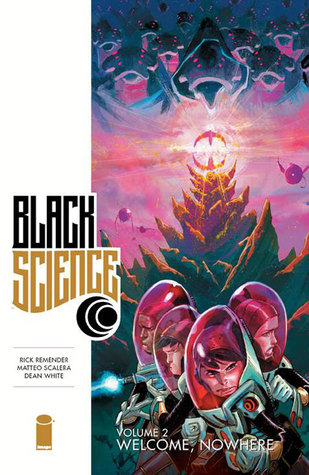
Though last week was rather busy, I did manage to get a fair bit of reading done: I had the pleasure of perusing Azzarello and Risso's Batman: Broken City (2004), the first volume of Hickman and Dragotta's East of West (The Promise, 2013), and the second volume of Remender and Scalera's Black Science (Welcome, Nowhere; 2015). The title of this review is shamelessly stolen from Remender and Scalera's Black Science.

For their first contribution to Batman's canon, dynamic duo Azzarello and Risso channel Frank Miller to create a quaint and curious volume of comic-book noir. While seeking justice for the victim of a hired killer, Azzarello's Batman waxes theological, soliloquizing in the rain while perched upon the cornices of Risso's Gotham, a baroque monument carved out of black shadows. Broken City is not a whodunnit so much as a whydunnit: we are not delving into the mystery of the murderer's identity – it is not at all a mystery; Batman tells us outright: it was Croc. We are instead made to wonder about the motivation of the person who ordered the hit, and forced to to consider what it means to share our fallen world with such monsters.

♀♀♀: Batman follows the trail of evidence through Gotham's underworld, repeatedly running into the mistress of a suspect, a woman named Margo Farr, who becomes something of a deuteragonist. Margo is clearly a "dame" after Frank Miller's heart; though coy to the point of cloying on her first meeting with the Dark Knight, she becomes bristly and evasive after he brushes off her advances. It is perhaps not entirely irrelevant to point out that all the women in Broken City are either murder victims or connected to the mob, often both.
0: This comic is not explicitly LGBTQA-inclusive.
πππ: Batman's most capable ally is detective Crispus Allen (whose name is inexplicably misspelled "Crispis"). His dialogue lays out more character than is customary for a character whose chief purpose is to disclose plot-precipitating information; much to his credit, Detective Allen is not exactly eager to trade notes with a vigilante. Azzarello introduces two Japanese mobsters named Fat Man and Little Boy, the former an amalgamation of sumo and yakuza, the latter a ninja with hints of geisha. Cringe-worthy as such characterization may seem to certain readers, Fat Man and Little Boy have at least some merit insofar as they manage to knock out the Batman.

For the first volume of East of West, Hickman delivers a very peculiar mash-up of alternate history and eschatology with a hint of King's Dark Tower series. In the aftermath of a mysterious cataclysm, North America was divided into seven warring nations. Wishing to exact vengeance upon the secret cabal of America's heads of states for the murder of his paramour, Death deserts his fellow Horsemen of the Apocalypse to exact his vengeance – oblivious to whatever part he may be playing in the prophesied End of the World.

♀♀: Through Hu interactions with her sister Xiaolian (Death's paramour), the reader catches a glimpse of a fraught, lifelike relationship.
0: This comic is not explicitly LGBTQA-inclusive.
ππππ: East of West's America – like actual America – is a land of immigrants: ethnically diverse and torn apart by racial tensions. Though they say very little, Nick Dragotta manages to infuse Wolf and Crow with a kind of sombre dignity that transcends stereotypes about America's First Nations.

Black Science's second volume unravels the skeins of fate and deception even further than the first, uncovering motivations which even the most astute reader could hardly have suspected and, in the process, redeeming characters with whom there was previously very little reason to sympathize. While the accursed Pillar is still forcing the dimensionauts to jump from world to world, Remender's formula has not gotten stale; Scalera's surrealistic landscapes do not fail to impress.

: Women dimensionauts continue to argue; Pia shows more determination than before.
0: This comic is not explicitly LGBTQA-inclusive.
ππππ: Welcome, Nowhere provides a great deal of backstory, including the origins of Kadir and the Native-American Techno-Shaman; both characters play increasingly significant roles.

Friday, March 06, 2015

Idiot Box Pull List – Week of March 1st, 2015


The Walking Dead S5 E12 – Remember
In his review of this week’s episode, Jeremy Egner of the New York Times calls our favourite bunch of survivors “a group of feral adapters straining against the bounds of polite existence.” He is not wrong.

Plot synopsis: Having arrived safely to Alexandria, Rick has a heart-to-heart with its head honcho, former congresswoman Deanna Munroe. Rick’s gang agrees to leave their firearms at the door (apparently, the zombie apocalypse is what it takes to make Americans reconsider the Second Amendment). Aaron shows Rick and Carl to their luxurious new home; Rick sheds his majestic beard and receives a haircut from Jessie, his affable new neighbour. One by one the survivors meet Deanna for an interview. The gang opts to sleep in the same living room for safety. Rick has something of a freak-out when Carl and Judith wander out of sight, and also a bit of a rage when the pistol he stashed in the woods goes missing. Carl follows the mysterious Enid through a secret passage beyond the wall and into the forest; after she gives him the slip, he loops around to the entrance for some zombie-slaying fun with dad. Tara, Glen and Noah try their hardest to tolerate the incompetence of the supply-run crew, but fisticuffs prove inevitable. In the end, Rick and Michonne are made constables and the survivors deem it safe to sleep in their own separate houses.

Notable line: “You said you're a family, that's what you said. It's absolutely amazing to me how people – with completely different backgrounds and nothing in common – can become that, don't you think?" Deanna Munroe calls attention to one of The Walking Dead’s central themes: the shifting boundary between in-group and out-group; the complex, volatile politics of that boundary.

Memorable moments: The way the survivors are bewildered by creature comforts provides the audience with a few choice opportunities to count their blessings. I was especially touched by Carl’s hesitation when faced with the choice between pool and video games.

♀♀♀♀: It is worth noting when the television series wanders off the comic's beaten path: making Deanna (a woman) the leader of the Alexandria community is one such departure from the comic script. The way in which Carol sells herself dramatically short in her interview is a particularly poignant counterpoint to Michonne’s more straightforward espousal of the Alexandria project. Is Carol downplaying her strengths for the tactical advantage, or out of nostalgia? Perhaps both?
RRR: Eric is nowhere to be seen and Aaron does not play a particularly significant part. That being said, it does look like he is going to be a fixture – haters be damned. And Tara does not stand back idly when Aiden has his tantrum, either.
πππ: Michonne is still one of the main instigators of the new social situation; Glenn’s left-hook to Aiden’s face may give the wrong idea about martial arts and Koreans, but it is much too satisfying for criticism.

. . .


Gotham S1 E18 – Everyone Has a Cobblepot
Moral ambiguity goes to 11 as even Gordon must temper his ethics with practicality.

Summary: In keeping with its formula, Gotham presents four independent plots. For this week’s case, Gordon teams up with DA Harvey Dent to track down Commissioner Loeb’s legendary stash of blackmail material after the latter forces Bullock to produce a false confession, exonerating the murderous Detective Flass. Gordon and Dent follow their first lead straight into a deathtrap; Bullock swoops in just in time to save them from a horde of knife-happy bookies. Their second lead has them visit Penguin, who has heard Falcone discuss a mysterious, out-of-the-way farm with the comissionner. Gordon, Bullock and Penguin investigate, hoping to uncover boxes of incriminating material but instead find Myriam, Loeb's matricidal daughter. Rather than bruiting the scandal, Gordon uses it to gain leverage over Loeb. Previously, during Jim Gordon’s visit to the hospital, a recovering Alfred Pennyworth stops Bruce Wayne from tattling on the man who stabbed him. We finally meet Dr. Dollmacher (Colm Feore); he and Fish Mooney have a number of conversations so as to establish the parameters of their business relationship. Finding herself in a precarious position, Fish must reiterate her promise to the prisoners whose very lives she uses as bargaining chips. Edward Nygma continues his futile attempts to woo Ms. Kringle.

Notable line: "You know, you tell yourself: I'll just do this one bad thing, but all the good things I do later will make up for it. But they don't. There's still that bad thing." It turns out there is moral fiber underneath Bullock's cynicism.

Memorable moment: Many elements of this episode stretch credibility; we are getting the surrealism we have come to expect from the comic-book source material (i.e.: an obsequiously sweet elderly couple turns homicidal at the drop of a hat, Dr. Dollmacher’s surgical patchworks).


♀♀: Chief Sarah Essen, Selina Kyle, and Myriam Loeb all play small but significant roles; Fish steals the show. Does Fish's new eye symbolize a novel outlook on life, and if so, is it a more compassionate or a more calculating perspective? Or is she becoming the Old Man of The Tell-Tale Heart? Be that as it may: none of the women interact directly or significantly with other women.
0: This episode is not explicitly LGBTQA-inclusive.
πππ: As previously mentionned, Fish and Chief Essen are featured prominently. I am not entirely sure what to make of the knife-wielding Chinese bookies.

. . .

Agents of S.H.I.E.L.D. S2 E11 – Aftershocks

Coulson's Agents of S.H.I.E.L.D. are back on the offensive.

Summary: In the aftermath of Skye’s exposure to the Terragen mist, S.H.I.E.L.D.’s last agents cope with the death of Agent Triplett each in their own way. Simmons fears a mutation pandemic; Fitz hides the results of Skye’s tests. Raina is none too pleased at having grown barbs; her attempted suicide is interrupted by a well-meaning capture mission which is itself interrupted by a mysterious teleporter. Hydra is looking to fill Whitehall’s vacancy, but the Agents of S.H.I.E.L.D. have plans of their own for their would-be ringleader Bakshi. Mockingbird and Agent Mackenzie are up to something, and it's probably nefarious.

Notable line: "Leper? I think you're a rockstar." Bobbie Morse could go undercover as a motivational speaker.

Memorable moment: Fitz is done feeling inadequate; he is now ready to share some of the last few months' hard-earned lessons. “You're just different now and there's nothing wrong with that."

♀♀♀♀: Much of this episode takes the form of conversations between Skye and other capable women (and men!) on either side of a safety glass.
0: This episode is not explicitly LGBTQA-inclusive.
πππ: People of colour play important parts. Even the dead: Agent Tripplet is gone but not soon forgotten, and the tone of much of the episode is rather funereal.

Thursday, February 26, 2015

Idiot Box Pull List - Week of February 22nd


Like most humans of the developed world, I enjoy television moving pictures on a screen. As most of the shows I watch are derived from the comic books I study, it occurs to me I should probably start thinking about them somewhat more critically. This is a first attempt.

. . .

The Walking Dead S5 E11 – The Distance
After Rick’s monologue last week, I was afraid not even an act of God could derail the grim train of thought the survivors have been on since Atlanta. It looks as though I was wrong and things are on the upswing.

Summary: Rick is not convinced that Aaron’s invitation to join a walled community is legitimate – after Woodbury and Terminus, can we blame him? Michonne provides an optimistic counterpoint to Rick’s paranoia. In order to verify the newcomer’s claims, Rick decides the best course of action is to take a car and an RV – which Aaron and his unseen accomplice have so generously provided – for a midnight drive. The writers stuff Aaron’s dialogue chock full of ambiguities and equivocations to stoke the fire of our suspicion. After splitting off upon encountering setbacks (and by “setbacks,” I mean: “shambling hordes of the undead”), team reconnaissance-car eventually reconvenes with the rest of the survivors in a decrepit warehouse. Aaron is reunited with his partner Eric whom the survivors apparently saved off-camera after he signaled his distress with a flare gun. The next morning they make their way to the gates of fabled Alexandria and everything is coming up Milhouse. (Or is it?)  

Notable line: “Even though you were wrong, you were still right.” Carol’s only line packs enough character to fill an entire episode.

Memorable moment: I wish I could say the most impactful scene was Aaron and Eric’s reunion, but I would be dishonest if I did not confess how I was overcome with perverse glee at the sight of a flare lodged into a walker’s face.

♀♀♀: Michonne is clearly a key player in this week’s episode.
RRRR: As a comic-reader, I had been looking forward to Aaron and Eric’s introduction; I continue to be grateful to the writers for keeping walking clichés out of my Walking Dead. Ross Marquand’s performance is no bit part; Aaron’s role as the instigator of this week’s plot was clearly established a week ago, before any details about his character became known to the TV audience. All things considered, this character introduction was remarkably on-key.
πππ: Both incarnations of The Walking Dead feature people of colour in positions of considerable agency. This episode is no exception.
. . .

Gotham S1 E17 – Red Hood
An object lesson on the fickleness of loyalty.

Summary: Five simultaneously-occurring, non-intersecting plots unravel over the course of this episode. Gordon and Bullock’s weekly investigation focuses on a series of high-profile bank robberies by the Red Hood Gang; the case pretty much cracks itself as in-fighting over the trademark hood tears the gang apart. A depressed Barbara Kean plays host to Ivy and Selina; Fish Mooney uses some unorthodox negotiation tactics at Dr.Dollmacher’s organ farm. Penguin receives unexpected help from Butch to get liquor for his failing club. Alfred Pennyworth is paid a visit by a guilt-ridden fellow veteran with questionable motives.

Notable line: “Perhaps it’s not our friends but our enemies that define us.” The Penguin, quoting U2’s Cedars of Lebanon by way of Arkham Origins.

Memorable moment: The final seconds of Fish’s negotiation session.

♀♀♀♀: Jada Pinket-Smith continues to shine as Fish Mooney. Selina’s cuttingly cynical response to Barbara’s lecture on the power of allure is almost subversive. Dr. Leslie Thompkins is sadly absent from this episode.
RRR: Showing LGBTQA characters (Barbara) in “ordinary” situations is an important aspect of representation.
πππ: While Fish Mooney steals the show, only one other person of colour gets a line. Chief of Police Sarah Essen, detectives Crispus Allen and Renée Montoya are all absent from this episode.

. . .

Agent Carter S1 E8 – Valediction
A season finale, hopefully not a series finale. 

Summary: Howard Stark and Edwin Jarvis surrender to the authorities in the aftermath of Dottie’s gas attack on a theater. The SSR sets up a trap for Dottie and Dr. Fennhoff using Howard Stark as bait. Dottie and Fennhoff outsmart the SSR, sending  a hypnotized policeman to capture Stark. The SSR rush to Stark’s secret hangar, arriving too late to prevent a hypnotized Howard from taking flight with a payload of deadly, psychosis-inducing gas. Carter and Dottie exchange words (and blows) in the control room where Fennhoff keeps feeding Stark hypnotic suggestion. Carter prevails; Fennhoff slips away; Carter talks Stark out of gassing Time Square and the day is saved. Meanwhile, Fennhoff’s words fall on Sousa’s deaf (err, plugged) ears and the latter serves the former an all-American knuckle sandwich. Later, at the secret SSR headquarters, Peggy Carter receives unanimous applause but Agent Thompson gets all the credit when the top brass drops in. Jarvis sets up Peggy and Angie in one of Stark’s houses and they all lived happily ever after.  

Notable line: “I know my value; anyone else’s opinion doesn’t really matter.” Margaret Carter’s post-conventional wisdom: applicable regardless of gender or creed. 

Memorable moment: Hayley Atwell’s sense of timing for repartee has been nothing short of stunning throughout the series.

Diversity score:♀♀♀♀: More than just a clash of female agencies, Agent Carter’s skirmish with Bridget Regan’s Dottie Underwood is a carefully choreographed articulation of conflicting philosophies.  
0: This episode is not explicitly LGBTQA-inclusive.
ππ: The only person of colour in this episode is the black policeman whom Fennhoff hypnotizes.

. . . 

Arrow S3 E15 – Nanda Parbat
The plot thickens as the series’s women approach center stage.

Summary: Against Oliver’s wishes, Thea confesses to Laurel how Sarah really died. In the aftermath of this conversation, Thea tips the League of Assassins as to Merlyn’s whereabouts. Laurel tracks down and engages Merlyn as Black Canary; he proves the superior fighter until Nyssa and her acolytes descend upon him. Oliver fails to prevent Merlyn from being taken away to Nanda Parbat to face the League of Assassin's draconian brand of justice, though he does manage to capture Nyssa. Nyssa gladly discloses Nanda Parbat’s location, fully expecting Team Arrow to fail in their rescue attempt. Oliver and Diggle borrow an ARGUS jet from Lyla, lead a two-men assault on the League’s headquarters, and are captured. Instead of executing them, Ra’s al Ghul makes Oliver an offer he can’t refuse. Meanwhile, back at Team Arrow’s headquarters, Thea frees Nyssa and tells her – a professional killer – how she murdered the her lover, because airing grievances is part of the healing process and there is absolutely no way that could go catastrophically wrong. Oh, and Felicity stops Ray Palmer from blowing himself up while building the A.T.O.M. suit and they have CW sexy-times.

Notable line: “This whole situation has gone from endearingly eccentric to creepily not okay.” Felicity, putting her foot down.

Memorable moment: Ray Palmer’s post-coital epiphany which leads to Iron Man’s the A.T.O.M. suit’s first flight.

♀♀♀♀: This week’s plot is more or less entirely precipitated by Thea and Laurel’s conversation near the start of the episode. Both Thea and Laurel show remarkable strength of character standing up to Oliver, just as Felicity demonstrates the use of cool reason and moderation is more productive than Ray Palmer’s obsessiveness. Male characters still pull most of the strings, however.
RRR: Nyssa al Ghul’s conversation with Laurel about the moment she fell in love with Sarah gives us crucial insight into her character’s emotional depth. 
πππ: It is simultaneously refreshing and touching to see Diggle – the action hero – interact with his infant daughter.

Monday, February 23, 2015

Writing and Drawing the Dark Knight


Writing and drawing are two very different crafts. When a creator takes it upon himself to do both, the resulting fusion of art and storytelling can take the reader to unexpected places.

In Batman: Odyssey (2010-2012), Neal Adams attempts to show up James Joyce by making Bruce Wayne his very own Leopold Bloom. Like his modernist predecessor, the DC veteran takes a great deal of liberty with classical tropes: catabasis and cyclops make the cut, empowered female characters do not. The Homeric journey is stretched to cover less familiar territory where the reader meets Neanderthals, trolls, mutant Egyptian gods, and jive-talking mages.

(Matt Fraction’s gender-swapping Ody-C exhibits radically different sensibilities).

Thematically, the product of this collision between ancient inspiration and the modern male power fantasy is predictably uneven. At times Odyssey reads more like a retrospective of Neal Adams’ contributions to the Batman mythos than anything else: Deadman, the League of Assassins and Man-Bat all feature very prominently. As a spectral guide to the underworld, Deadman’s responsibility to Batman and Robin is like that of Virgil’s to Dante. The underworld in this case is a hollow earth overpopulated with dinosaurs, a fantasy cliché which, while satisfying in a gee-whiz sort of way, cannot help but remind the wary reader of Neal Adams’ climate-change denying theories of Earth’s expansion.

While Odyssey is all over the place when it comes to plot, themes and characterization, its narration is certainly very consistent: every episode is introduced and narrated by beefcake Bruce Wayne sitting across a table from an unseen interlocutor whose point of view the reader shares. Inexcusably, most of the frame story’s dialogue takes place in front of a computer-generated backdrop which could not have seemed less contrived even at the height of the nineties. Adams’ layouts masterfully integrate text, the flow of which is most easily intuited on his splash pages. The writer/illustrator's script is unfortunately not on the same level as his artistic vision: I frequently found myself looking back to previous frames or pages for fear of having read them out of sequence only to find out my confusion stemmed not from misleading layouts but rather from awkward or repetitive pieces of dialogue.

Diversity score:
:  None of the series’ fourteen issues depict a woman who is not under the direct and complete control of a man. Even Talia al Ghul is merely a pawn in her father's schemes.
0: The series is not explicitly LGBTQA-inclusive.
ππ: While Sensei, Ra's and Talia Al-Ghul all have significant impacts on Odyssey's plot, they tend to conform to the common stereotype of the scheming "oriental" mastermind. Moreover, the physiology of the craven primitives whom Batman and Robin must beat into compliance is worryingly reminiscent of caricatures based on racial stereotypes.

. . .

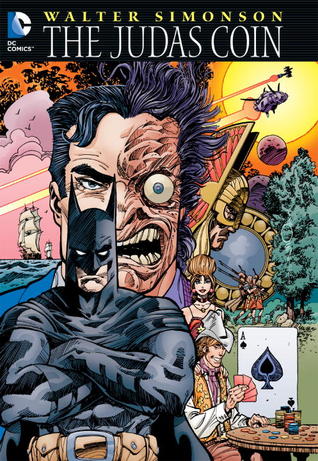
Walter Simonson's The Judas Coin (2012) tells six stories happening around the same cursed object: one of the thirty shekels of Judas Iscarioth's reward. The first tale is but a brief introduction, an account of Judas' last days which, instead of making a religious statement of any kind, focusses on the convoluted circumstances through which the coin came to line the pockets of a murderer. The second story skips 40 years forward as the coin travels to Celtic Europe by way of Roman legionnaires; the third takes place some 900 years afterwards, when Northerners go a-Viking on Welsh shores. The fourth episode follows the coin upon the High Seas during the golden age of piracy; the fifth, featuring Bat Lash, has the cursed piece of silver land in the Wild West. The sixth takes us at last to the "present day," where Batman has a run-in with Two-Face at the Gotham Historical Museum. The seventh and last tale, something of an epilogue, tracks the coin into the far future when it crosses paths with a certain Manhunter.

Simonson uses each self-contained story as an opportunity to explore a radically different artistic style. The sixth episode especially is a bit of a formalist experiment, forcing the reader to view the album at a 90 degrees angle and interspersing comic frames with ersatz newspaper clippings. Every story exhibits the creator's concern for setting: where Adams would be content to use a blur in lieu a background, Simonson gives us careful recreations of historical environments.

Diversity score:
:  Two of the seven stories show women exerting agency: in the second, we meet Ardra, a leader of the Celts;  in the seventh, the thieves Ledora and Fenette give Manhunter a run for his money.
0: This graphic novel is not explicitly LGBTQA-inclusive.
0: People of colour are alluded to once in flashback sequence, but are not otherwise represented in this graphic novel.

Friday, February 20, 2015

The Bechdel Test + The Vito Russo Test + The π Index


I believe it is not scandalous to suppose popular imaginaries contribute to the shaping of social reality: consequently, inclusive representation in fiction should be a matter of consideration in criticism. I have decided to formalize my appreciation for diversity in the form of a variation on two popular sets of criteria (the Bechdel test and the Vito Russo test). Going forward, all of my reviews will feature a short section rating fictions between and ♀♀♀♀ based on the following standards (with each criterion being worth one ):

1. The fiction features a woman who "has a name," or who is "tied into the plot in such a way that [her] removal would have a significant effect."
2. This woman talks about something other than a man ...
3. ... to another woman ...
4. ... who also "has a name."

The answer as to whether or not a fiction passes the Bechdel test will therefore take one of the following five formats:

0, or ♀♀: Fail: this fiction does not explicitly represent women's voices or women's worlds.
♀♀♀: This fiction comes close to representing women's voices or women's worlds.
♀♀♀♀: Pass: this fiction stands out for its representation of women's voices and women's worlds.

I will also consider whether the fictions I review pass the Vito Russo test for LGBTQA-inclusiveness. I will be taking into account the following criteria, each worth one R.

1. The fiction features a character who is identifiably LGBTQA.
2. This character is not "solely or predominantly defined by their sexual orientation or gender identity."
3. This character is "tied into the plot in such a way that their removal would have a significant effect" (i.e.: the character is not there merely to support a heteronormative character's story).
4. Supererogatory: This character interacts with at least one other identifiably LGBTQA character; this criterion cannot be met if 2 is not also fulfilled.

And so: fictions will receive one of five possible R scores:

0 or R: The fiction is not explicitly LGBTQA-inclusive.
RR: The fiction is somewhat LGBTQA-inclusive.
RRR: The fiction is noticeably LGBTQA-inclusive. 
RRRR: The fiction stands out on account of its LGBTQA-inclusiveness.

Lastly, I propose to adapt the Vito Russo test to assess the representations of people of colour using the following benchmarks:

1. The fiction features a character who is a person of colour. Non-human sapients do not count unless the issue of their rights and/or integration factors significantly into the plot.
2. This character cannot be summarized by popular stereotypes about people of colour.
3. This character is "tied into the plot in such a way that their removal would have a significant effect" (i.e.: the character is not there merely to support a white character's story).
4. Supererogatory: This character interacts with at least one other person of colour; this criterion cannot be met if 2 is not also fulfilled.

I will grant one π for each criterion, for a possibility of five different ratings on what I have termed "the π index":

0 or π: The fiction is not explicitly PoC-inclusive.
ππ: The fiction is somewhat PoC-inclusive.
πππ: The fiction is noticeably PoC-inclusive.
ππππ: The fiction stands out on account of its PoC-inclusiveness.

I understand none of these yardsticks provide a perfect measure of inclusiveness: meeting most (or all) of the criteria does not automatically place a work above criticism  nor is a fiction which does not conform to any of these standards necessarily bereft of aesthetic merit. These tests can nevertheless be used to jump-start a critical discussion; nuances which cannot be summarized by a four-point scale will have to receive more detailed attention under the relevant heading. Furthermore, I prefer to err on the side of inclusiveness: if an interaction between significant women characters is not exclusively about men, it will score a ♀♀♀♀.

Friday, February 13, 2015

Metanarrative as a Roadmap to Parallel Universes: "Multiversity" and "Black Science"


Ahead of Convergence – the event which will bring about “an end” to the current phase of the DC multiverse, but not (we are told) to its New Earth setting – Dan Didio has announced changes in editorial guidelines intended to put diverse storytelling approaches before such paltry things as canon and continuity. Whereas there is little doubt that 75 years of contradicting narratives might stick in the craw of a new reader intent on getting acquainted with the DC multiverse, it would be a mistake to operate under the assumption that a more streamlined setting might make complex exposition unnecessary. To be sure, comics’ most celebrated stories rarely depend on the reader’s acquaintance with lore: following the principle of Chekhov’s gun, writers tend to incorporate only the most relevant references to previous works. Be that as it may, crises and retcons would not have become a genre unto themselves if they did not speak to the interests of a significant portion of the comic-reading audience.

It is therefore not unreasonable to surmise that genre readers experience anagnorisis differently than the audiences of other fictions – the comic-reader, looking for coherence beyond the episodic plots, embarks on a personal quest to piece together the metanarrative of an expanding fictional continuum. The editors at DC have not been particularly consistent about providing clear directions on this journey: the original crisis (On Infinite Earths) is the only one of its kind to have a substantial metanarrative epilogue (History of the DC Universe, in which Harbinger details the consequences of the event on continuity). While Final Crisis is certainly a metanarrative – a story encompassing stories – it also raises more questions than it answers.

Grant Morrison’s Multiversity (especially its latest issue, the Guidebook) harkens back to Final Crisis, in part to tie up some of its loose ends, but mainly so as to connect disparate narratives within a coherent, purposeful whole. Despite the inadequate prose of some of its entries, the Multiversity Guidebook conveys a powerful sense of the explosion of narrative into metanarrative, forcing a reflexion on the relevance (or irrelevance) of canons in fiction.

Multiversity
combines metanarrative with metafiction: multiple elements of the setting call attention to the artifactual character of stories, up to and including the metanarrative. Resuscitating a trope from The Flash of Two Worlds, Morrison shows the DC multiverse is held together by the comics medium in a kind of holographic structure: every realm is represented in every other realm in the form of a comic (interestingly, Batman comes to this realization the same way we do: by reading the Guidebook). Metafiction permeates the whole of DC's metaphysic down to its very nomenclature: the orrery of worlds is suspended in an aether called the Bleed, which is to say, in comic-book parlance, the image that runs off the page.

Metanarrative does not have to be an explicit or central element of plot. Most of the exposition in the first volume of Remender and Scalera’s Black Science is not metanarrative per se: the reader is instead made to dance around the story’s chronology, beginning in medias res (as is customary) before witnessing the chain of events leading to the plot trigger in a series of cleverly interspersed flashbacks. Grant McKay and his fellow dimensionauts are adrift in the quantum eververse, the maelstrom of all possible worlds. Though the action of Black Science focuses on a singular narrative thread (that is to say: it does not have to cope with the narrative entropy of a shared universe) it nevertheless has a highly ingenious way of intuiting that other narratives beyond the purview of the reader are equally relevant, especially insofar as they involve alternate-universe versions of the protagonist. The “reality” of the story is thereby shown to be derived from an arbitrary impulse of the reader, a fortuitous consequence of the inclination to make the first given information the central point of any interpretive scheme.

Friday, February 06, 2015

"There is no good side here." – Gail Simone's "The Movement"


In May 2014, the Tumblrs groaned: Gail Simone’s latest team-book was scheduled for cancellation with what seemed at the time like very little editorial fanfare. New characters at DC have not had very much luck this past decade; I was holding out hope The Movement might break the pattern. I was disappointed, if not altogether surprised.

(The title of this review is shamelessly lifted from the second volume of the series.)

As the protectors of their benighted urban setting of Coral City’s low-income neighborhood, the superpowered members of the Movement assume more complex roles than typical vigilantes. Between scenes of violence, our heroes work alongside muggle allies at improvised soup kitchens, shelters, and classrooms. While the scenes of urban domesticity give the book some grassroots credibility -- providing a moral counterpoint to the more straightforward styles of problem-solving traditionally promoted by the genre -- the Movement’s political endgame remains exceedingly vague. Altercations with a plethora of unrelated antagonists are made more complex than necessary by dissension within the ranks, creating a kafkaesque climate of all-against-all which tends to undermine the book’s message of pacifism and class solidarity. 

The Movement’s roster of misfit heroes boasts more diversity than the Planeteers: four of its six members are women, three of whom are women of colour. Virtue (née Holly Ann Fields) is a powerful empath capable of tapping into all of the energies of the emotional spectrum. As the practical, street-smart leader of the titular group, Virtue knows how to attract people to her cause: she is aided in her social justice mission by the geokinetic Tremor (Roshanna Chatterji, a transfer from Simone’s pre-Nu52 Secret Six); Katharsis (Kulap Villaysack), a former cop with a flight-suit and a very large collection of grudges; Vengeance Moth (Drew Fisher), a self-effacing wheelchair-user with energy-construct powers; Mouse (Jayden Revell), a kooky rat empath; and Burden (otherwise known as Christopher), a troubled teen with the ability to change into any one of the many demons that haunt his fervid religious imagination. 

Burden’s perspective as an inexperienced newcomer to seedy Coral City often serves as the reader’s way into The Movement’s fallen world. Though Burden’s naïveté is at times an excellent pretext for entertaining pathos, I suspect it also proves a very awkward fit for many readers; I was grateful for Batgirl’s cameos for providing a different, less obstructed point-of-view.

Ultimately, The Movement does not really break away from the conventions of the bourgeois power-fantasy: despite the book's emphasis on social issues, Coral City's beleaguered proletariat is not given any alternative to standing in a crossfire. Be that as it may, it would not be entirely fair to suggest Simone plays up class struggle as a shortcut to thematic substance. We must take into consideration the fact that The Movement’s storytelling style is consistent with its overt gospel of diversity: instead of a singular view of a narrative centered on objective violence, we are given multiple angles on a plot elaborated around complex interpersonal drama. While there is some evidence to suggest The Movement bit more than it could chew – tackling too many issues without giving any of them the nuance and attention it deserves – it is not unreasonable to suppose the need to wrap things up before cancellation affected the pace. When all is said and done, DC Comics should have given The Movement a much longer run in consideration of Simone’s concern for inclusiveness: cancelling the series on account of underwhelming sales flies in the face of the socially-progressive values the publisher professes to uphold.

Monday, January 19, 2015

For your edification ...


Coursera is showcasing an interesting selection of lecture series this winter, with subjects ranging from game theory to online surveilance law. I think I might watch some of the lectures on fantasy and science fiction if time allows, perhaps while I perform my morning exercises. Last semester I watched part of a series on comic books and graphic novels; I could not complete it due to conflicting commitments, but it was extremely refreshing to get a different perspective on the subject.

I recently watched and re-watched Don Hertzfeldt's It's Such a Beautiful Day, which was made available on Canadian Netflix a short while ago. It is truly a masterful piece of storytelling, articulating a deeply troubling impressionistic portrayal of mental illness through a series of clever philosophical vignettes. I was particularly impressed by the way in which Hertzfeldt utilizes space, cutting it up like an astute comic-book artist while making this division of the visual field stand for simultaneity instead of sequence.

Saturday, January 10, 2015

Resolutions and Recommendations


January in Québec is cold and dreary; one of the only potentially good things about it is New Year's resolutions. Amongst other things, I have resolved to organize my online presence, and so I moved all of my creative writing from 2006 to the present onto another blog in order for this space to be fully dedicated to my half-baked ideas short critical essays. I am superlatively grateful to Zoe from Chic & Sassy Designs for the new-and-improved template. 

Also a resolution: to prepare more of my food

Another good thing about January is the abundance of recommendations appearing in the form of yearly reviews. After consulting Paste, CBR, Comics Alliance, and Mental Floss, I have settled on the following shortlist of tomes I definitely want to add to my collection:

- She-Hulk by Charles Soule, Javier Pulido and Ron Wemberly
Moon Knight by Warren Ellis and Declan Shalvey
Lumberjanes written and illustrated by the inimitable Noelle Stevenson (whose excellent Nimona can be read online).
The latest Saga hardcover by Brian K. Vaughan and Fiona Staples
The Wicked + the Divine by Kieron Gillen and Jamie McKelvie
Through the Woods, written and illustrated by Emily Carroll

I will also be adding these titles to my wishlist (in case anyone feels generous):

- Here, a formalist experiment by Richard McGuire
- The Wake by Scott Snyder and Sean Murphy
- Jolies ténèbres by Marie Pommepuy et Sébastien Cosset (collectively known as Kerascoët)
- East of West by Jonathan Hickman and Nick Dragotta
- Pretty Deadly by Kelly Sue DeConnick and Emma Rios
- Lazarus by Greg Rucka and Michael Lark

If I have not included certain of the more popular titles on this list (particularly, G. W. Wilson's Ms. Marvel or Grant Morrison's Multiversity), it is in some cases because I already own them. Indeed, I have recently reviewed Ms. Marvel and I very much look forward to its second volume. My pull-list currently consists of Multiversity, Justice League Dark, Constantine, The Sandman: Overture --and I systematically pre-order every hardcover/TPB of Aquaman, Wonder Woman and Swamp Thing.

I am also extremely excited about A. David Lewis' American Comics, Literary Theory and Religion (of which I have received a review copy; a first in my academic career). I do worry it may make my own work redundant.

What are you looking forward to reading in 2015?

Tuesday, January 06, 2015

"Men kill for the truth because they do not know how to live for it." -- G.W. Wilson's "Air"


The title for this review is stolen from the second volume
of G. Willow Wilson’s Air.

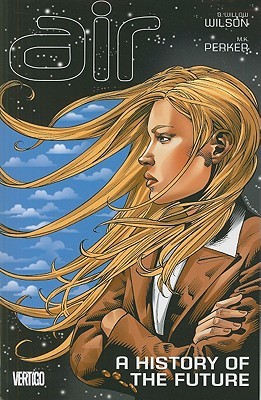
From 2008 to 2010, G. Willow Wilson chronicled the trials and tribulations of Blythe Cameron, hyperpract extraordinaire. Hyperpracts are (mostly) women and (much more rarely) men, ordinary in every respect except for their singular intuition and fierce imagination. Given the right circumstances, hyperpracts are capable of tapping into the essence of things, manipulating the symbols which ontologically pre-figure reality in order to produce a variety of thaumaturgic effects (though mainly: efficient, expedient air travel).

If my pseudo-metaphysical verbiage does not truly give it justice, it is because Wilson’s Air is utterly unpigeon-holeable. Air is a treatise on the power of words, a meditation on the origins of ideas, a thesis on liminality; it is a narratologist’s fantasy. Air is a pamphlet against both fundamentalism and the extremes of relativism, arguing that symbols are too wild and too precious to bow to any agenda. While certainly a highly satisfying alternate-history/sci-fi yarn, Air is above all a love story -- though not by any means a straightforward one.

Wilson is particularly adept at presenting us multilayered characters, progressively revealing their motivations by unraveling the intricate web of their allegiances. We make acquaintance with certain very colourful organizations in the process, some which we might wish were real -- sky-faring gypsies and punk-rock mujahideens -- others which we cannot help but hate for embodying our own paranoid, parochialist tendencies.

Blythe Cameron is a complicated personna in that she alternates between tumbleweed passivity and extremes of resourcefulness; one might charitably suppose this to be the path a traveller must walk to find herself in a world of unknowables. Thinking back on the story as a whole, I am grateful to observe a tendency towards increasing agency is indeed part of Blythe's evolution.

M.K. Perker’s art is a model of restraint; action scenes (and even hallucinations) are depicted with rare tact and sobriety, leaving more than enough breathing room for the reader’s imagination -- and not a little ambiguity.

Sunday, December 07, 2014

Weëna


Minnesota, my brother and sister-in-law's feline roommate.
Catsitting takes me out of my usual element. My brother and sister-in-law borrowed some bédés from the local library, and so I read the first two volumes of Éric Corbeyran and Alice Picard's Weëna, an earnest (if derivative) attempt at mythopoeia which may not be available in English at this time. 

Weëna follows the titular character's quest to escape the dark destiny prophesied at the moment of her birth by a grim spectre. The deuteragonist, a young aristocrat with an unpronounceable name, seeks to marry Weëna in order to break an unspecified curse on his bloodline through the sacrifice of their hypothetical firstborn. With the perinatal portents, magical allies and trials of initiation, it sometimes feels as though the author must be writing the script between the lines of a fantasy tropes checklist. All of the characters wear their motivations on their sleeve, making absolutely certain to soliloquize in the most grandiloquent manner at every given opportunity. This penchant for awkward dialogue and frankly juvenile melodrama is highly unfortunate, as poor exposition detracts from the exploration of what might be an intricate and fascinating mythology.

Picard conjures enchanting scenery and striking fauna; the layouts, while not particularly innovative, serve the story well. I personally don't feel compelled to find out what happens to our young heroine, but I suppose there are worse ways to spend an hour with a cat.