Pages

Showing posts with label fantasy. Show all posts

Tuesday, January 06, 2015

"Men kill for the truth because they do not know how to live for it." -- G.W. Wilson's "Air"


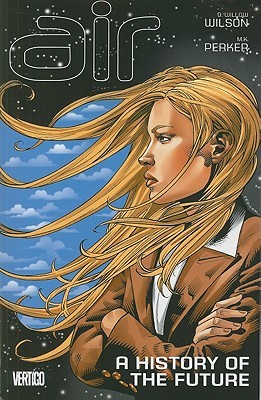
The title for this review is stolen from the second volume
of G. Willow Wilson’s Air.

From 2008 to 2010, G. Willow Wilson chronicled the trials and tribulations of Blythe Cameron, hyperpract extraordinaire. Hyperpracts are (mostly) women and (much more rarely) men, ordinary in every respect except for their singular intuition and fierce imagination. Given the right circumstances, hyperpracts are capable of tapping into the essence of things, manipulating the symbols which ontologically pre-figure reality in order to produce a variety of thaumaturgic effects (though mainly: efficient, expedient air travel).

If my pseudo-metaphysical verbiage does not truly give it justice, it is because Wilson’s Air is utterly unpigeon-holeable. Air is a treatise on the power of words, a meditation on the origins of ideas, a thesis on liminality; it is a narratologist’s fantasy. Air is a pamphlet against both fundamentalism and the extremes of relativism, arguing that symbols are too wild and too precious to bow to any agenda. While certainly a highly satisfying alternate-history/sci-fi yarn, Air is above all a love story -- though not by any means a straightforward one.

Wilson is particularly adept at presenting us multilayered characters, progressively revealing their motivations by unraveling the intricate web of their allegiances. We make acquaintance with certain very colourful organizations in the process, some which we might wish were real -- sky-faring gypsies and punk-rock mujahideens -- others which we cannot help but hate for embodying our own paranoid, parochialist tendencies.

Blythe Cameron is a complicated personna in that she alternates between tumbleweed passivity and extremes of resourcefulness; one might charitably suppose this to be the path a traveller must walk to find herself in a world of unknowables. Thinking back on the story as a whole, I am grateful to observe a tendency towards increasing agency is indeed part of Blythe's evolution.

M.K. Perker’s art is a model of restraint; action scenes (and even hallucinations) are depicted with rare tact and sobriety, leaving more than enough breathing room for the reader’s imagination -- and not a little ambiguity.

Sunday, December 07, 2014

Weëna


Minnesota, my brother and sister-in-law's feline roommate.
Catsitting takes me out of my usual element. My brother and sister-in-law borrowed some bédés from the local library, and so I read the first two volumes of Éric Corbeyran and Alice Picard's Weëna, an earnest (if derivative) attempt at mythopoeia which may not be available in English at this time. 

Weëna follows the titular character's quest to escape the dark destiny prophesied at the moment of her birth by a grim spectre. The deuteragonist, a young aristocrat with an unpronounceable name, seeks to marry Weëna in order to break an unspecified curse on his bloodline through the sacrifice of their hypothetical firstborn. With the perinatal portents, magical allies and trials of initiation, it sometimes feels as though the author must be writing the script between the lines of a fantasy tropes checklist. All of the characters wear their motivations on their sleeve, making absolutely certain to soliloquize in the most grandiloquent manner at every given opportunity. This penchant for awkward dialogue and frankly juvenile melodrama is highly unfortunate, as poor exposition detracts from the exploration of what might be an intricate and fascinating mythology.

Picard conjures enchanting scenery and striking fauna; the layouts, while not particularly innovative, serve the story well. I personally don't feel compelled to find out what happens to our young heroine, but I suppose there are worse ways to spend an hour with a cat.

Friday, December 05, 2014

"Good is not a thing you are, it's a thing you do" : 3 Reviews


This week I read two (relatively) recent anthologies: the first volume of G. Willow Wilson and Adrian Alphona’s Ms. Marvel, followed by Jeff Lemire and Terry Dodson’s Teen Titans: Earth One. I also perused yet another first volume, the New 52’s Voodoo by Ron Marz, Josh Williamson and Sam Basri. The title of this post is lifted from the pages of Ms. Marvel.
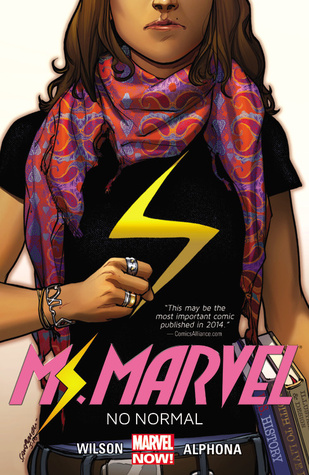
The first six issues of the new Ms. Marvel’s adventures are collected under the fitting title of No Normal, the implication being not only that there is nothing ordinary about a shape-shifting teenager in a world of marvels and monsters, but also that normalcy is itself a construct without any real moral status. Kamala Khan’s struggle to control her newfound powers mirrors her search for a functional identity; the usual sources are not forthcoming with solutions to either problem. American/secular values and familial/religious authority are shown to be as ill-equipped to assist Kamala with her shape-shifting abilities as they are ineffectual at helping her navigate her dual identity. 

No Normal is moreover highly atypical for a superhero story arc: we don’t encounter a real villain before issue 4, and none of the altercations show Ms. Marvel achieve unambiguous victory through the use of force. The focus is decidedly on character development, which is achieved through her many interactions with a colourful cast of New Jerseyan high-schoolers, wage-earners and misfits. Though it may not conform to the expectations of most readers, this focus on character development does not make for a slow pace: fortunately for us, Kamala has a knack for getting into trouble, and her Jersey City environment is depicted in such a vibrant way as to provide much comic relief.

No Normal has many highly interesting things to say about religion and ethics, but it shies away from giving any single character the theological or moral upper-hand. The numenal is encountered in a surrealistic dream-state which is almost a parody of both superhero fiction and traditional iconography. The conversational style of the hierophany undermines the traditional separation of sacred and profane, standing in stark contrast to the stodgy moralism of school and mosque.

+ Watch this insightful video on how Kamala Khan is changing the world of media for the better.
+ Read these G. Willow Wilson interviews with CBR and the New York Times.

. . .

Lemire and Dodson’s Teen Titans is a reimagining of the celebrated Wolfman/Pérez creation for the low-fantasy series Earth One. Focussing on a teen-aged ensemble cast rather than on a single adult protagonist (as in the Superman and Batman novels of the same series) makes for a very different kind of book. The plot’s progress is somewhat hampered by the need to provide background for all six of the main characters so that by the end of the first volume there are still more questions than answers.

In this new incarnation, the Titans are connected by more than just their heroic proclivities; five of them are orphans recruited without their consent into a Star Labs experiment. One can hardly help but wonder how much of the novel’s conflict makes sense seeing how most of it could have been avoided through a few lines of realistic dialogue. The plot depends rather excessively on the teenagers’ rebelliousness and extreme distrust of authority, perhaps even more so than it does on the cynical machinations of machiavellian scientist Elinore Stone.

Despite the seemingly gratuitous conflict, it is interesting to see the trope of the “evil stepmother” subverted in that at least some of  the Titans' foster-parents’ grow genuinely attached to the test-subjects. On the other hand, I am not sure how to interpret Lemire’s decision to make Elinore the architect of Cyborg (instead of Silas, Cyborg’s father in the original Wolfman/Pérez run). As much as I am in favour of reinterpreting popular narratives to include more women in positions of power and prestige, it is not clear to me that turning a martyr into an evil mastermind is an improvement on the source material. 

. . .
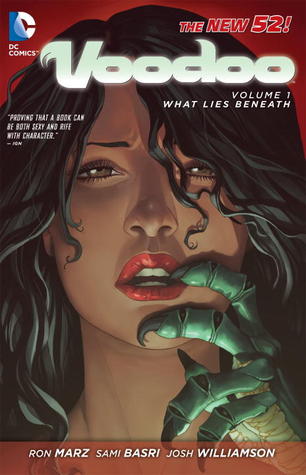
Having not read the whole of WildStorm’s Stormwatch/The Authority, I cannot really comment on Voodoo’s (un)faithfulness to earlier source material. The titular character is a mind-reading, shape-shifting human/Daemonite hybrid sent to report on Earth’s heroes in advance of an alien invasion. Marz, Williamson and Basri’s take on the character unapologetically straddles the line between representation and reproduction: while the decision to have a shape-shifting spy pose as a dancer in a strip-club attended by military types makes sense for plotting purposes, Basri’s treatment of the subject leaves little doubt that sexualization was the primary motivation for this creative direction. In fairness to Basri, it could be noted that Voodoo is rarely as sexualized in the story proper as much as she is on the Tyler covers; moreover, Basri exerts remarkable restraint in his imaginative depictions of brutal mayhem.

A vague sense of “the search for truth” drives a fast-paced plot as Voodoo alienates herself from both sides of her hybrid identity, leaving many bloody corpses in her wake. Her only capable, non-superpowered antagonist is revenge-driven special-ops investigator Jessica Fallon; ordinary men are expendable yokels whose hormones rule out the very possibility of free will or lifelike personality. Kyle Rayner/Green Lantern and a new Black Jack are thrown into the fray to remind readers of the larger DC universe in which this otherwise straightforward sci-fi thriller takes place. By the end of the volume, the reader is left in very much the same position as the protagonist, knowing neither where to go nor for which faction to root.

Sunday, November 30, 2014

"The only people reading are fanboys who don't count": thoughts on Morrison’s X-Men


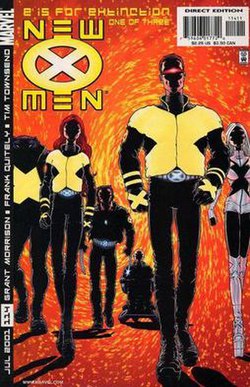
I recently read the first two volumes of Grant Morrison’s New X-Men (issues 114-126). Here are some of my impressions:

There are expressions one only ever encounters in Morrison’s works -- phrases such as “I feel like a Hindu sex god” that fall so far outside the category of verisimilar dialogue as to create a genre all of their own. That “sex god” line is delivered by Henry McCoy/Beast, a modern Chiron whose character usually emphasizes sophistication over animality. I do not begrudge Morrison’s eagerness to expose the mainstream to esoteric concepts and turns of phrase, but I rather wish he would do so in a manner that is more mindful of precedents.

The initial arc of Morrison’s run introduces Cassandra Nova, the first of a new psychokinetic species, an evil parody of Charles Xavier. In lieu of the usual characterization, Morrison develops Cassandra Nova as part of a purpose-driven extinction machine, putting forward an evolutionary theory of species-wide apoptosis.Though this is not the first time Xavier is shown to have an evil double, previous writers have shied away from making this trope the cornerstone of any pseudo-scientific eschatology. This is certainly a matter of taste, but I find that -- in the interest of narrative flow -- it may be preferable for writers of speculative fiction not to construct elaborate rationalizations for the scientific plausibility of their scenarios, as this only draws attention to those magical/mythical elements which most contemporary readers are eager to take as given.

The second arc deals mainly with the U-Men, a group unscrupulous transhumanists harvesting mutant organs. The U-Men have a frontman in the person of Elon Musk lookalike John Sublime, but the concept of their movement is actually introduced by a school-shooting teenager. It is refreshing to see the enemy manifest as a largely leaderless ideology instead of a government and/or corporate conspiracy against an innocent minority. 

Quitely’s art is at its most expressive when depicting unseemly mutations; one does not get the impression that the students at Xavier’s are part of a fortunate genetic elite. More than in perhaps any previous incarnation of the X-Men, the reader is confronted with abhorrent disfigurations. Even the more iconic characters are shown in a less dignifying light, often appearing without any kind of distinctive attire. The New X-Men’s work uniforms are clearly more functional than ritual.

Emma Frost, the only exception to this rule, is probably the series’ most problematic character. She is never shown without her X-shaped bikini: one supposes it can stand for either body-positive female-empowerment or male-gaze slavery, but lectio dificilior potior suggests the latter is more likely. I wonder whether Frost’s Machiavellian morality can credibly extend to embrace the instrumentalization of the feminine form.

In an eleven-page manifesto dated October 20th 2000, Morrison states his intention to make the X-Men “cool again,” complaining about the sacrosanctity of status quo in the superhero comic genre.


“ The only people reading are fanboys who don't count. [...] Longtime fans will read the book and bitch about it no matter what. We don’t need to attract them, we need to make the book accessible to the real-world audience. [...] We need to recapture the college and hipster audience because that audience is bigger than ever, and thanks to the movies and games [...] the entire mainstream is pumped and primed to consume super-hero stories.”

With hindsight, it is clear that Morrison’s intuition was largely correct: almost 15 years after his memorable X-Men run, superhero narratives are more popular and influential than ever. Be that as it may, it does not seem as though the superhero paradigm has been in any way subverted. With few exceptions, the superhero narratives developed for mainstream audiences are even more archetypal than their comic-book counterparts. We watch the Marvel cinematic universe with the expectation that an unambiguously prosocial contingent will triumph without suffering significant losses to equally unambiguously antisocial forces -- and our expectations are seldom disappointed. As Northrop Frye wrote in Anatomy of Criticism, "[… W]e could almost define popular literature […] as literature which affords an unobstructed view of archetypes."

Thursday, November 20, 2014

Some thoughts on Chris Claremont's X-Men


I just finished the third volume of Essential X-Men. I had previously been perusing volumes 1 and 2, which means I'm about 68 issues into the Chris Claremont run (in addition to having read a few annuals). I was excited to witness the introduction of iconic characters such as Storm, Nightcrawler, Colossus, and Kitty Pride (not yet known as Shadowcat). These early issues also feature the death, resurrection and second demise of Jean Grey and the Days of Future Past story arc. Here are a some of my thoughts, in no particular order:

Colour is a valuable interpretational aide in comics. Not only does it convey mood (by way of lighting), it also facilitates the decoding of graphically-complex situations. I won't be buying more of the black-and-white Essential editions (unless they come cheap).

Apart from some very male-gaze-oriented outfits and a few gratuitous shower scenes, Claremont's X-Men is relatively light on the sexism. Many issues even pass the Bechdel test. Practically all of the female characters are given complex, independent personalities. Storm is a particularly capable squadron leader (and indeed: much more suited to the task than Cyclops). Claremont does buy into some gender stereotypes in that his female characters seem somewhat more susceptible to irrational fits than their male counterparts (i.e. the Phoenix Force, Storm's claustrophobia which cause her to lash out).

The world of the X-Men is fairly diverse. White Americans are in the minority on the second X-Men roster. Claremont's depictions of foreign and minority personalities are not unproblematic (there's a good deal of exoticizing and some rather ludicrous patois) but the most stereotypical character (the Apache Thunderbird) is sacrificed a few issues after his introduction. One is glad, for once, for the noble-savage-dying-for-his-colonial-friend trope.

Claremont dialogue is better than I remember it to be. I have often mocked action scenes which depict characters delivering long diatribes between punches. The balance between exposition (tell) and depiction (show) is certainly different from what a contemporary comic-reading audience might expect or enjoy, but it's not unjustifiable from a story-telling standpoint. It was a different era with different conventions; many of Claremont's ideas could not easily have been communicated without extensive speech- or thought-bubble commentary.

Claremont has interesting ideas about religion. In issue #108, he throws some kabbalah at us: 
 "In that instant -- as she feels her power, the power of her friends, sing within her; as she reenergizes the energy lattice -- it's as if a door has opened before her eyes. A new pattern forms -- shaped like the mystic tree of life -- with Xavier its lofty crown and Colossus its base. Each X-Man has a place, each a purpose greater than himself or herself. And the heart of the tree, the catalyst that binds these wayward souls together, is Phoenix. Tiphareth. Child of the sun, child of life, the vision of the harmony of things."
It is not at all suprising that Phoenix was designated to undergo apotheosis, but I am at a loss to explain why Claremont opted for kabbalah as his frame of reference for mysticism. Claremont's Jewish heritage notwithstanding, it seems to me as though there might have been more popular or obvious options at the time. It is possible he chose kabbalah precisely because it was not exceedingly well-known. I am not convinced his interpretation of the sephirot is kosher, but I am not an expert. Perhaps this is irrelevant, or perhaps it is cultural instrumentalization -- I am not sure.

In X-Men Annual #4, Doctor Strange accompanies the X-Men on a trip through Dante's Inferno to rescue Nightcrawler. I am not at all sure what to make of that issue.